You’re just off the green. Plenty of green to work with. Nothing fancy required. Then you catch the chip flush on the equator and send it screaming across the putting surface like you’re trying to hit a stinger with a lob wedge.
That shot is maddening because it feels like you did almost nothing wrong. But that’s exactly the point. Bladed chips usually don’t come from one huge mistake. They come from a small breakdown in the strike location. Your club bottoms out too early, your body stalls, your hands try to help the ball up and the leading edge catches the middle of the ball instead of the turf underneath it.
Why you blade short chips
Most golfers blade short chips for the same reason: they try to lift the ball instead of brushing the ground under it.
When your sternum hangs back, your weight drifts to your trail side or your wrists flip through impact, the low point of the swing slides behind the ball. That makes clean contact almost impossible. Sometimes you hit it fat. Sometimes you blade it. Either way, the strike is unstable because the bottom of the swing is in the wrong place.
The simplest fix: Keep your chest forward and turning
If you want one simple way to stop blading short chips, here it is: keep your chest slightly ahead of the ball and keep it moving through the shot.
At setup, put about 60 to 70 percent of your pressure on your lead foot. Narrow your stance. Play the ball middle to slightly back of center. Let your hands sit just a touch ahead, not dramatically pressed forward. From there, make a small, controlled motion with your chest, arms and club moving together.
That’s the key. Together.
The chest keeps turning. The handle keeps moving. The club brushes the turf under the ball. No scoop. No slap. No last-second rescue move. When your chest stays forward and continues to rotate, your low point stays in front of the ball, where it belongs.
What it should feel like
It should feel boring.
That’s good.
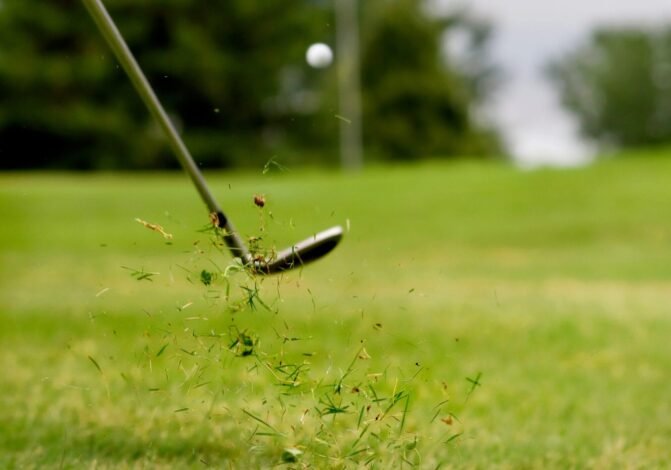
A solid short chip should feel like a tiny swing with almost no drama. Your chest turns a little. Your arms go along for the ride. The clubhead stays low to the ground through impact. You hear a quick brush of the grass, not a loud slap and not nothing at all.
If you’re hitting good chips, you won’t feel like you’re helping the ball into the air. The loft on the club does that. Your job is to deliver the bottom of the swing slightly ahead of the ball and let the club do what it was built to do. Better players do this consistently by keeping pressure forward and controlling the low point, not by making some magical hand action.
The mistakes that bring the blade back
The first mistake is leaning back through the shot. The moment your chest falls behind the ball, the low point falls behind it, too.
The second mistake is trying to pop the ball up with your wrists. That flip adds loft but destroys strike.
The third mistake is stopping your body and throwing the clubhead past your hands. That’s a classic blade pattern. Your pivot quits, the clubhead passes too early and the leading edge wins.
The fourth mistake is putting the ball too far forward. That can work for a higher, softer shot, but for the stock chip most golfers need, it makes it harder to control the strike. A middle-to-slightly-back ball position with modest forward pressure is a much more reliable place to live.

A drill that makes it stick
Place a club or alignment stick on the ground just behind the ball. Now hit short chips while keeping your pressure on your lead side and your chest turning through.
The goal is simple: miss the object behind the ball and still clip the chip cleanly.
If your weight hangs back, if your hands flip or if your chest stops, you’ll hit behind the ball right away. The feedback is immediate. That’s why this drill works. It teaches you to keep the low point forward without overthinking mechanics.
The simple truth
Bladed short chips are usually not a wedge problem. They’re not a bounce problem. They’re not bad luck.
They’re a low-point problem.
Stop trying to lift the ball. Set up with a little pressure forward. Keep your chest slightly ahead. Keep it turning through the shot. Do that and the strike cleans up fast.
That’s the simplest way to stop blading short chips.