
Next Gen
PIF ATP Next Gen Accelerator 2026: How the programme works & who qualifies
How junior, college and Top 500 players can access ATP Challenger and ATP 250s
April 23, 2026
Corinne Dubreuil/ATP Tour
Rafael Jodar qualified for the 2026 PIF ATP Next Gen Accelerator by being inside the Top 500 of the PIF ATP Rankings.
By Jerome Coombe
The evolution of the ATP Tour’s development pathway continues in 2026, with the PIF ATP Next Gen Accelerator strengthening its role in supporting the sport’s most promising young players.
Backed by the PIF, the programme represents a long-term investment in the future of tennis, targeting players at the earliest stages of their professional journeys and offering a clearer, more structured route to the top of the sport.
The PIF ATP Next Gen Accelerator creates additional playing opportunities on the ATP Tour for those who earn eligibility through performance across junior, college and professional pathways.
In 2026, players aged 20 and under ranked inside the Top 500 of the PIF ATP Rankings can access eight main-draw spots at ATP Challenger 50 or 75 events. Those inside the Top 350 are eligible for eight main-draw or qualifying spots at ATP Challenger 100 or 125 events, while players ranked inside the Top 250 can receive one main-draw spot and two qualifying spots at certain ATP 250 tournaments.
The programme also supports leading talent from outside the professional rankings. The Top 20 players in the ITF Junior World Rankings and ITA Collegiate Rankings are eligible for eight main-draw or qualifying opportunities at ATP Challenger 50 or 75 events, ensuring a direct pathway from both junior and college tennis into the ATP Tour.
Tournament access is delivered through designated weeks in the ATP calendar, where Next Gen Accelerator spots are allocated by the ATP based on ranking priority. The next such week will be the week of 8 June, featuring ‘s-Hertogenbosch and Stuttgart.
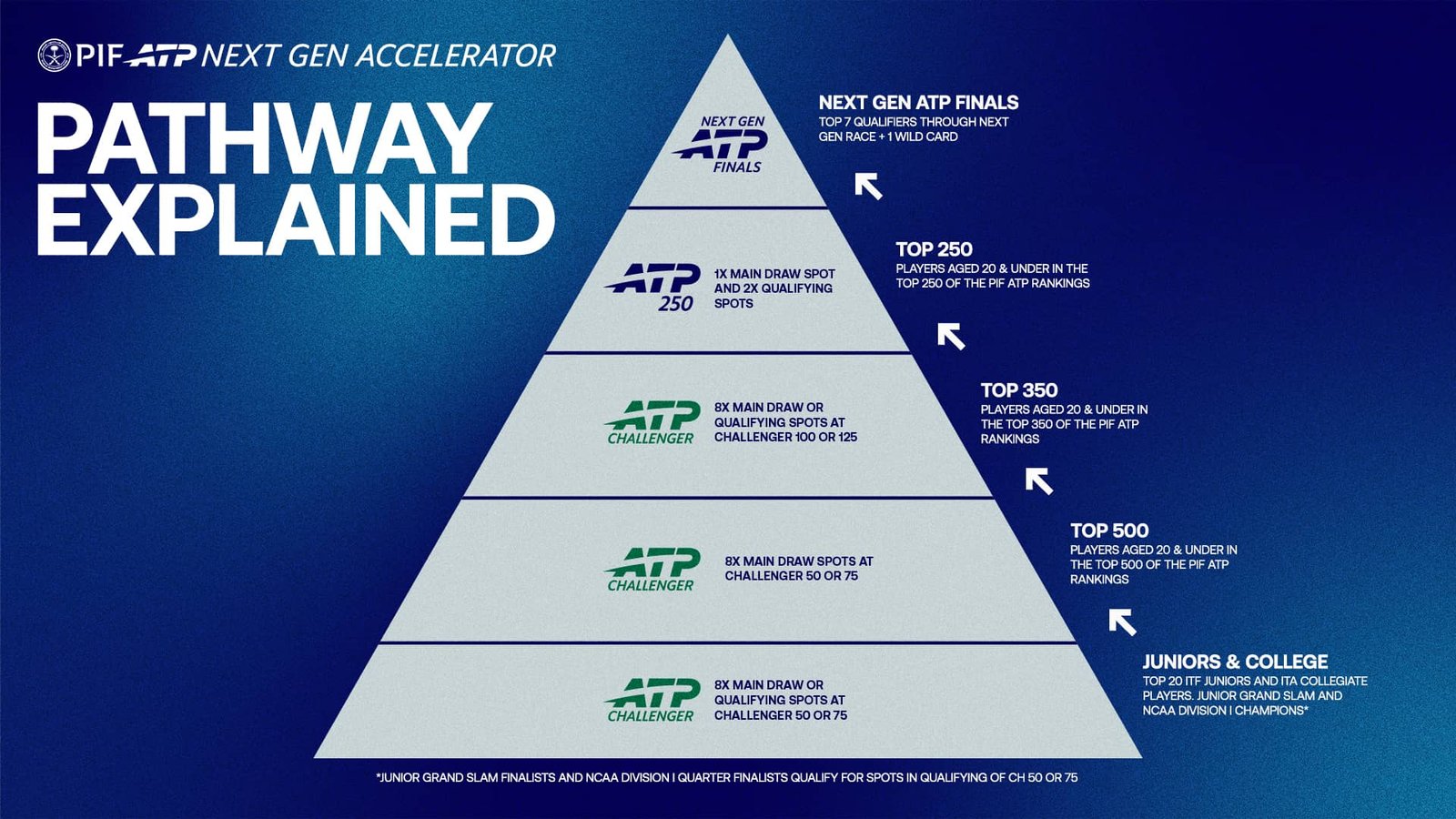
The impact of the programme is already clear. Brazil’s Joao Fonseca used the PIF ATP Next Gen Accelerator last year to enter the ATP 250 event in Buenos Aires, where he went on to win his first ATP Tour title. This year, Spain’s Martin Landaluce has gained access to the ATP 250 in Brisbane and the ATP Challenger 125 in Monza through the programme.
“This programme allows me to escalate in the rankings more easily because I can play tournaments that I wouldn’t be able to without this help,” Landaluce said last year. “I’m very privileged and grateful to have this. I think it’s a nice programme and hopefully it can help other young players.”
Beyond tournament access, the initiative integrates a range of support designed to help players develop on and off the court. A key addition in 2026 is Tennis IQ powered by PIF, an advanced analytics platform offering match insights, opponent scouting and video analysis, helping players make more informed decisions and accelerate their development.
Players can also benefit from financial support to access wearable technology, enabling them to track workload, movement and recovery. Combined with expert guidance, these tools are designed to support performance, improve preparation and reduce the risk of injury.
To help manage the financial demands of competing, players receive $1,000 per ATP Challenger event entered, up to $12,000 annually, contributing to travel and competition-related costs during key development years. Additional support is available for health insurance and medical expenses, providing greater stability as players build their careers.
Education is another core component of the programme. A structured series of masterclasses and workshops runs throughout the season, covering topics such as mental health, injury prevention, integrity and business literacy. These sessions are delivered by ATP experts, PIF ambassadors and leading figures from the sport, including Rafael Nadal, who earlier this year shared insights on life on Tour during a Q&A with players, coaches, agents and family members.
The 2026 PIF ATP Next Gen Accelerator brings together performance opportunity and structured support within a single system. By linking qualification, ranking progression and tournament access with technology, education and financial backing, it provides a clear and sustainable pathway for young players to move through the levels of the game and onto the ATP Tour.