Formula One’s 2026 regulatory cycle was always going to be a seismic shift, but few expected the competitive picture to become so politically charged so quickly.
The introduction of the Additional Development and Upgrade Opportunities mechanism—ADUO—has created a new strategic battleground, one where raw horsepower, regulatory interpretation, and timing intersect in ways that could redefine the competitive order.
And with early independent estimates suggesting meaningful gaps between the manufacturers’ internal combustion engines, the stakes have rarely been higher.
At its core, ADUO is the FIA’s attempt to prevent a repeat of past eras in which a single power unit dominated for years. Rather than handicapping the strongest engine, the system gives the weaker ones more freedom to catch up.
The mechanism is built around a single metric: the ICE Performance Index, defined in FIA‑F1‑DOC‑096. This index evaluates only the internal combustion engine, deliberately excluding hybrid deployment, energy recovery efficiency, battery technology, and MGU‑K control strategies.
The FIA’s logic is simple: hybrid systems are too easily “gamed” if the criteria are public, whereas ICE output is a more stable and measurable foundation for convergence.
Evaluation windows
The season is divided into three evaluation windows—Rounds 1–6, 7–12, and 13–18—during which the FIA compares every manufacturer’s ICE Performance Index to the best-performing engine. If a manufacturer is at least 2% down but less than 4% behind, it earns one additional homologation upgrade for the current season and one for the next.
If the deficit reaches 4% or more, the allowance doubles: two upgrades this year, two the next. These opportunities are not cumulative within a season, and manufacturers that fail to qualify in the first two windows cannot suddenly enter the system in the final period.
The FIA also reserves the right to intervene if the upgrades themselves create a new imbalance, ensuring ADUO remains a convergence tool rather than a loophole.
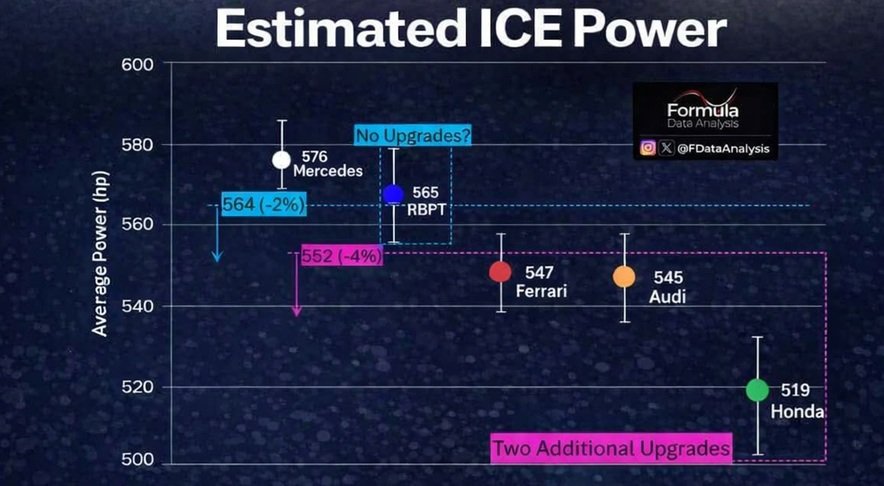
This regulatory scaffolding has become especially relevant in light of early independent estimates of ICE power. According to data compiled by F1DataAnalysis, Mercedes currently sits at the top of the pile with an estimated 576 horsepower.
That figure establishes the benchmark against which all other manufacturers will be judged. The 2% threshold—564 hp—marks the line for one upgrade per season, while the 4% threshold—552 hp—opens the door to two.
Red Bull Powertrains finds itself in an unexpectedly precarious position. With an estimated 565 hp, RBPT sits just above the 2% cutoff. On paper, that means they may not qualify for any ADUO allowances at all. The irony is that their deficit to Mercedes is small enough to deny them upgrades, yet large enough to matter in a season where every horsepower is magnified by the new hybrid architecture.
Complicating matters further is the fact that Red Bull’s early‑season struggles have been attributed more to chassis limitations than to the power unit itself. Racing Bulls’ strong relative performance reinforces that interpretation: the PU appears competitive, but the car is not. In a system that evaluates only the ICE, RBPT may find itself locked out of additional development freedom despite being marginally behind.
Ferrari’s situation is more nuanced. Their estimated output—between 547 and 560 hp depending on the evaluation method—places them somewhere between a 16‑ and 29‑horsepower deficit to Mercedes. That range straddles both ADUO thresholds.
Ferrari has been open in stating that it expects to qualify for upgrades, with team principal Frédéric Vasseur calling ADUO “an opportunity for us to close the gap.”
If the FIA’s internal measurements align with the lower end of the estimates, Ferrari could receive one upgrade per season; if they align with the higher deficit, they could receive two. The Scuderia has already hinted that it has additional ICE upgrades in the pipeline, and ADUO could accelerate their deployment.
Audi and Honda appear to be the clearest beneficiaries. With estimated outputs around 545 hp for Audi and 519 hp for Honda, both fall comfortably beyond the 4% threshold.
That would entitle them to two upgrades this season and two more next year, a significant advantage in a regulatory era where development is otherwise tightly restricted. For Audi, still integrating its works programme and refining its first‑generation hybrid architecture, this could be a lifeline. For Honda, whose return as a full manufacturer coincides with a challenging start, ADUO may be the mechanism that keeps its customer teams in the competitive conversation.
Questions to be answered
The political dimension of ADUO cannot be ignored. The FIA has deliberately avoided publishing the exact metrics used to calculate the ICE Performance Index, aware that manufacturers might attempt to manipulate the system if the criteria were transparent.
This opacity has created uncertainty, but it also protects the integrity of the process. Teams cannot “sandbag” their way into upgrades, nor can they design engines that perform poorly in specific metrics to trigger allowances. The FIA’s ability to request additional data from teams and manufacturers further strengthens the system’s robustness.
The cancellation of the Bahrain and Saudi Arabian Grands Prix has introduced an additional wrinkle. The FIA must now decide whether to maintain the original six‑race evaluation window—ending after Monaco—or to shift the first assessment to Miami as originally planned. That decision could materially affect which manufacturers qualify for ADUO in the first window, especially those hovering near the thresholds.
What is clear is that the early horsepower estimates have injected urgency into the ADUO conversation. Mercedes’ strong baseline puts them in the unfamiliar position of defending an advantage under a system designed to erode it.
RBPT faces the uncomfortable prospect of being too close to the benchmark to qualify for help. Ferrari stands on the cusp of a regulatory windfall that could reshape its season. Audi and Honda, meanwhile, may be poised to benefit from the most generous allowances available.