Jim Furyk is a curious choice, as a back-up choice and second-chance captain of next year’s U.S. Ryder Cup team. If the PGA of America, in consultation with its Ryder Cup committee, wanted to go down the been-there, done-that road, why not just bring back last year’s model, Keegan Bradley, fresh off his Lessons Learned Tour? Yes, Europe won that event, 15-13. But being a winner was not a prerequisite for the job, and Bradley’s 11 players had some rally-cap Sunday.
The team Furyk captained in 2018, in France, appeared to be sleep-walking through all three days of the event, losing 17.5 to 10.5. The American golfer Tiger Woods appeared to be sleep-sitting through Team USA’s au revoir press conference Sunday night. Woods hasn’t been in a Ryder Cup uniform since then, not in a playing role, not in a managing role, not in any role except sideline whisperer.
Woods was always a Furyk guy. He related to him, grinder to grinder. Bradley was a Phil Mickelson acolyte.
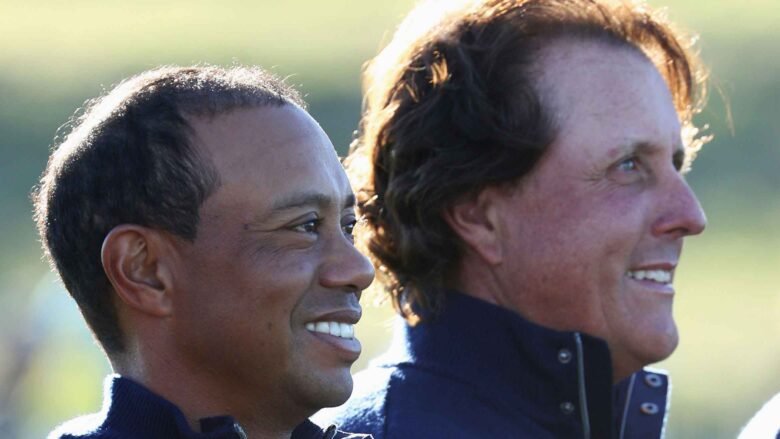
The elephant in the room here is the absence of Woods and Mickelson as Ryder Cup captains, at least for now and maybe forever. The two dominant figures of American golf over the past 30 years, with 127 PGA Tour wins between them, including six PGA Championships, nowhere to be seen. There is no faster summary of the costs of their off-course lives, than that, that neither of these titans of the game is in the Ryder Cup conversation.
Woods, without saying a word, has shown himself to be an irresponsible driver with deep levels of trauma in his life. Mickelson, using a torrent of words, turned his back on his home tour, costing it incalculable damage. Even in this age of metrics, there is no device that could measure the weirdness, or the void.
Once upon a time, it was easy to imagine Mickelson captaining the 2023 team in Italy and the 2025 team at Bethpage Black, and Woods managing the 2027 team in Ireland and the 2029 team at Hazeltine. Maybe it was all a pandemic fever dream. It seems, like the pandemic itself, forever ago.
So, just to put it in one place, here are your six recent-vintage U.S. Ryder Cup captains, plus the next one:
*2018, France, Jim Furyk;
*2021, Whistling Straits, Steve Stricker;
*2023, Italy, Zach Johnson;
*2025, Bethpage Black, Keegan Bradley;
*2027, Ireland, Jim Furyk.
Talk about tried-and-true. Four-for-five, right there. (No one saw Bradley coming, not at 39.) Once upon a time, Arnold Palmer, at age 34, was given the Ryder Cup reins, but that was then (1963). On this list, Steve Stricker is the outlier: He had never won a major! But he was a native son of Wisconsin. Stricker was too modest and too honest to claim any particular role in the U.S. victory in Kohler, Wisc. “Brooks and Bryson wanted to play together — that’s how much [this team] came together,” he said when it was all over. Brooks Koepka and Bryson DeChambeau. They may be frenemies now, but they weren’t then. Stricker did what any good manager, in any field, does: get his players in a place where they can do the thing they do, play golf at a high level. It’s not that complicated, despite the extreme efforts to make it seem so.
Broadly speaking, the PGA of America is in a tough spot. Waiting on Tiger, waiting and waiting for him to make a decision, didn’t help. The organization still must deal with the worst aspects of last year’s Ryder Cup at Bethpage Black on Long Island, where the PGA of America failed in its ultimate responsibilities, to provide a safe and appropriate atmosphere for spectators and to be a welcoming and gracious host to our European visitors.
The PGA Championship at Aronimink next month, on the far outskirts of Philadelphia, will be a major test, but also an opportunity, for an organization in a state of tumult. Four CEOs in an eight-year period, for one thing. The audacious move from Palm Beach Gardens, Fla., to Frisco, Texas, outside Dallas, for another. That has been a hard sell all the way around. Future PGA Championships are scheduled for the largely untested new course there, one owned and operated by the PGA of America. The unspoken goal is obvious: make more money. Never an inspiring comment for any true sports fan to hear. The greatness of the Ryder Cup is that it became a money-maker by accident. It became a phenomenon by way of Seve Ballesteros and Jose-Maria Olazabal, Paul Azinger and Payne Stewart, Paul McGinley and Ian Poulter, even Patrick Reed and Bryson DeChambeau. It became the Ryder Cup by dint of personality and the quality of the play, coupled with some exquisite American stages. Here’s looking at you, Oak Hill in early fall, in Rochester, N.Y.
The captain’s job, when you really get it to its essence, is to fill out a lineup card, help set the mood, engage the public. With Jim Furyk, who turns 56 next month, we know what we’re getting. His whole golfing life is rooted in relentless consistency, and it has served him well. DeChambeau, who is 32, would have been a wildcard as a Ryder Cup captain, and a wild choice. But if recent history on this narrow subject has shown us anything, don’t postpone joy. Do not postpone joy when picking Ryder Cup captains. The committee waited too long on Tiger and Lefty. Elvis has left the building. Tiger has, too.
Michael Bamberger welcomes your comments at Michael.Bamberger@Golf.com