How do you know who the best golfers in the world really are?
There are, of course, the scores they shoot in tournament competition. But there’s also the surrounding context: where they shot them and against what level of competition. But it’s more complex than you might think. Between the various tours, formats and tournaments played across the globe, all those matrices of scores can make for a jumbled mess of digits on different websites and platforms across the internet.
Increasingly, a solution for golf fans is the website DataGolf. Official world rankings serve their own purpose but have their limitations, too, failing to account for the skill displayed in an eight-shot vs. one-shot victory, or the complexity of awarding points to new tours (though that’s another conversation altogether). Most of the issues contextualizing the men’s game have been solved by DataGolf for years, but the women’s game always lagged well behind
But now it’s catching up.
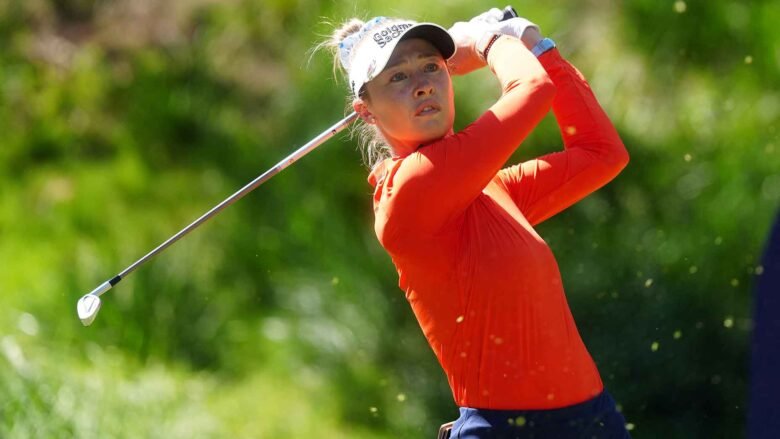
Starting this week, DataGolf now has a women’s ranking to rival its men’s ranking, the newest, clearest, cleanest way to explain if Nelly Korda really is playing better golf than Jeeno Thitikul.
Essentially, DataGolf rankings are an assessment of how a pro golfer’s results in the tournaments they play stack up against others in that field as well as every other field. If you play well anywhere, it’s going to look good for you, in terms of Strokes Gained against an elite-golf (PGA or LPGA Tour) average. If you play well against a field of elite golfers, it’s going to prove a higher skill level, too. Similarly, playing poorly anywhere isn’t good, and playing poorly against a low-quality field is worst of all.
So, who’s atop the initial DataGolf women’s ranking?
It’s Korda, then Thitikul, then HyoJoo Kim, the same top three, though in a different order, as the Rolex world rankings. But the real value of the rankings arrives a bit further down the DataGolf list. There exists a significant portion of high-level women’s golf that is based almost entirely in Asia, and those players may not find themselves in the same field as Korda more than once or twice a season. They play a lot of their golf in Japan or Korea, and Korda almost never makes the trip across the Pacific Ocean. While that may be an issue for the LPGA Tour, it’s also just an issue for people trying to embrace the sport. Those trying to engage with it, follow its characters and understand the context of each tournament each week.
DataGolf’s ninth-ranked player — just ahead of last week’s LPGA winner Hannah Green — is 23-year-old Shuri Sakuma, who has played a total of five LPGA events in her entire life, none of them in America. Four of them have been in her home country of Japan, where she absolutely dominates the JLPGA. Sakuma has won four times on the JLPGA in the last 12 months, and as a result finds herself in this week’s field at The Chevron. Sakuma is decidedly not in the same ballpark as Korda, but she might be closer than we would have thought before this ranking came along.
Another fun DataGolf feature is how the skill index can explain the dominance of top players compared to their peers. And while we will never really be able to properly measure Scottie Scheffler’s ball-hitting brilliance against Korda’s, the DG Index for each tells a similar story. Scheffler’s 2.96 rating is nearly a stroke greater than No. 2 in the men’s game, Jon Rahm (2.19), while Korda’s dominance isn’t quite as great (2.7) and her lead over Thitikul is narrower (2.45).
While that may not mean a ton right now, it would have been awesome to compare the two a couple years ago, when Korda was winning basically every LPGA tournament … and Scheffler was doing the same on the PGA Tour. Considering basically no one was beating them, maybe we didn’t need any numbers to explain it better, but it’s plausible that Korda’s dominance in the women’s game was actually outstripping Scheffler’s in the mens’ game.
Thankfully, the people behind DataGolf have promised it will back-date plenty of these numbers to the year 2000, with some forthcoming content around the all-time stretches of Annika Sorenstam and Lorena Ochoa.
Stay tuned.