Despite the all-new power units, mechanical reliability has been relatively strong across the field in the first three races of the 2026 F1 season. F1Technical’s senior writer Balazs Szabo delivers his latest anaylsis.
The 2026 Formula 1 season has ushered in the most transformative power‑unit regulations since the hybrid era began, reshaping not only how engines are built but also how teams must manage them across a record‑length calendar.
The new power units retain the familiar hybrid structure but with a dramatically altered balance between combustion and electrical power. Each unit is composed of six key elements: the Internal Combustion Engine (ICE), the Turbocharger (TC), the Exhaust system (EXH), the Motor Generator Unit‑Kinetic (MGU‑K), the Energy Store (ES), and the Control Electronics (CE).
With the removal of the MGU‑H, the MGU‑K now plays a far more central role, supported by a higher‑capacity battery and simplified turbo architecture. These changes have increased the thermal and electrical demands on the system, making reliability management more critical than ever.
To keep the season competitive and prevent excessive component swapping, the FIA has set strict usage limits. Each driver may use up to four ICEs, four Turbochargers, and four Exhaust sets, along with three MGU‑Ks, three Energy Stores, and three Control Electronics units.
However, the 2026 rules introduce a new twist: one additional “bonus” allocation for each component category. This gives teams slightly more breathing room as they adapt to the new hybrid architecture, but with 24 races on the calendar, the margin for error remains slim.
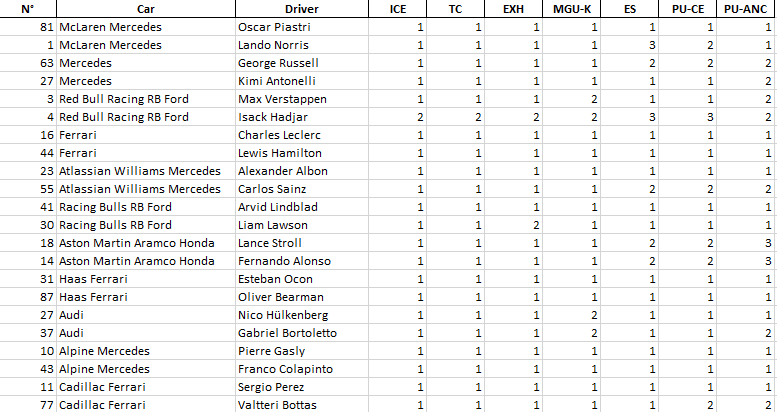
Three rounds into the season, the early patterns of component usage reveal a field that has largely avoided major reliability scares. Most drivers remain on their first ICE, Turbocharger, Exhaust, MGU‑K, and Energy Store, suggesting that the new‑generation power units have launched with impressive baseline robustness.
The first signs of divergence appear in the Control Electronics and related ancillary systems, where several drivers — including George Russell, Kimi Antonelli, Lando Norris, Max Verstappen, Isack Hadjar, Carlos Sainz, Lance Stroll, Fernando Alonso, Esteban Ocon, Gabriel Bortoleto, and Valtteri Bottas — have already moved onto their second or third CE and PU-ANC unit.
The most notable outlier so far is Red Bull’s Isack Hadjar, who has already used two ICEs, two Turbochargers, two Exhaust systems, and two MGU‑Ks. This level of consumption so early in the season is unusual and may point to a reliability concern, a precautionary change, or a thermal‑management issue specific to his chassis.
Elsewhere, teams like Audi show isolated spikes in electrical component usage. The overall picture is one of strong reliability across the grid, but with early hints of where the pressure points may emerge as the season progresses.