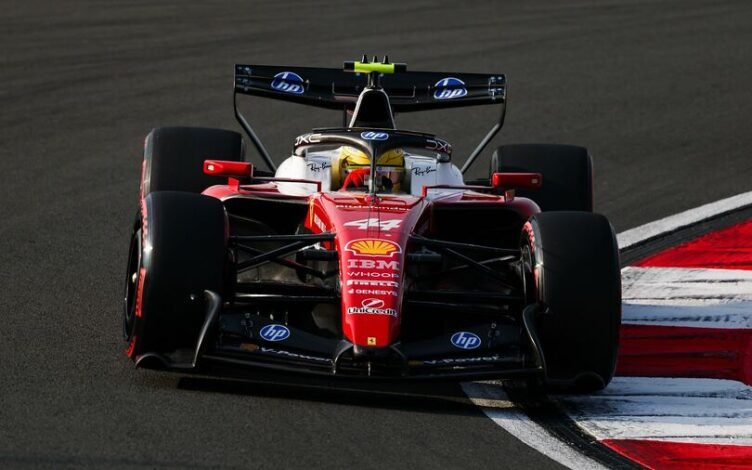
Ferrari continued its aggressive development push for the Miami Grand Prix by testing a substantially revised version of its innovative “Macarena” rear wing during a filming day at Monza on Wednesday.
The session, limited to 200 km of running, offered Charles Leclerc and Lewis Hamilton their first opportunity to validate several key aerodynamic upgrades after a five‑week break in the 2026 Formula 1 season.
With the cancellation of the Bahrain and Saudi Arabian Grands Prix compressing the early‑season development window, most teams are preparing to introduce their first major upgrade packages in Miami.
Ferrari—currently second in the championship but already 45 points behind Mercedes—has been working on a comprehensive update suite including a new floor, front wing, and the next evolution of its headline‑grabbing Macarena rear wing.
A deeply revised Macarena wing concept
Ferrari’s Macarena wing, first seen in Bahrain testing and briefly run in FP1 at the Chinese Grand Prix, has undergone a significant redesign following early‑season reliability concerns. The team avoided racing the concept in the opening three rounds, instead using the extended break after Japan to refine both its structural integrity and aerodynamic behaviour.
During the Monza filming day, Ferrari tested what sources describe as a “significantly” updated version of the wing. According to the reports the Scuderia has reworked the endplates, modified the actuator integration, and adjusted the geometry of the upper elements to improve airflow management and mechanical robustness.
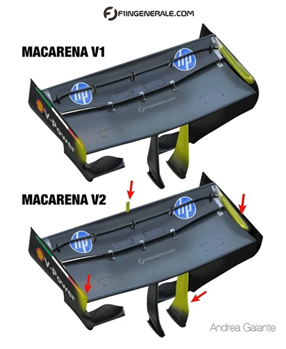
Key visual differences between Macarena V1 and V2
More squared‑off endplates
The V2 endplates adopt a sharper, more angular profile, replacing the rounded contours of the original design.
Repositioned pylons for structural rigidity
The support pylons have been shifted to improve load distribution and reduce flexing at high speed—an area Ferrari had been refining since the wing’s first appearance.
Smaller, steeper internal accents
The accents inside the endplates are now smaller and angled more steeply downward at their initial section, helping condition the airflow feeding the rotating flap.
New vertical flap on the third element
A distinctive vertical flap has been added to the centre of the third element, improving stability in the inverted‑profile configuration that defines the Macarena concept.
Actuator integration
The most consequential modification concerns the actuator that rotates the upper flap. Previously, the actuator’s placement intruded into the mainplane, creating unwanted aerodynamic disturbance—especially when the flap was closed.
Ferrari has now redesigned the endplate to house the actuator more cleanly, reducing its aerodynamic footprint. This change is intended to improve airflow management around the wing and enhance stability in both high‑downforce and low‑drag states.
This refinement is crucial for the Macarena concept, whose inverted‑profile geometry relies on precise airflow control to deliver its intended efficiency gains.