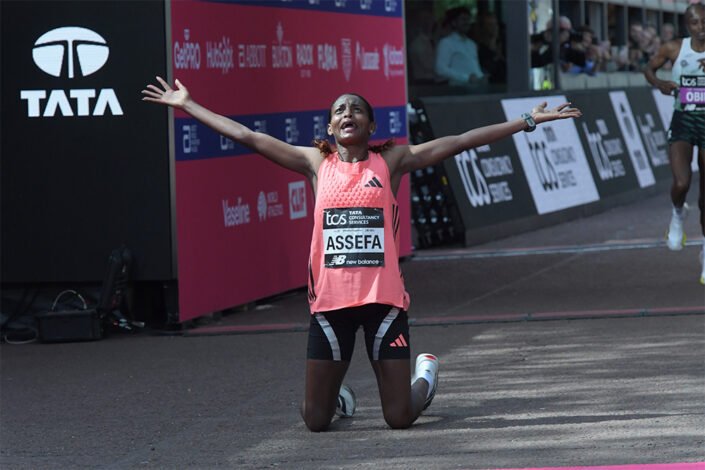
LONDON, ENGLAND, April 26 — On a day when the 2-hour barrier was broken in the men’s marathon, Tigst Assefa’s women-only WR of 2:15:41 was put slightly in the shade but that certainly shouldn’t be a slight on her superb run.
The diminutive Ethiopian had advertised at the pre-race press conference that her own ’25 London Marathon time of 2:15:50 was in her sights and the race was set up accordingly.
However, with the likes of former London and New York winner Joyciline Jepkosgei, who was 2nd behind Assefa here in 2025, and two-time Boston and New York champion Hellen Obiri on the start line, the ’24 OG and ’25 WC silver medalist who World Ranked No. 1 last year also knew she would have to bring her A-game.
Almost from the gun the race quickly boiled down to a leading pack of six: Jepkosgei, Obiri, fellow Kenyan Catherine Amanangole, Assefa, the latter’s Ethiopian compatriot Degitu Azimeraw and Bahrain’s Eunice Chumba. They flew through 5K in a super-quick 15:39.
And the next 5K was quicker still, with 10K passed in 31:03 — which extrapolates to a 2:11:00 finish. Azimeraw and Chumba not surprisingly found the pace too hot to handle even at this early stage in the race.
And then there were three.
The running remained relentless despite a slight easing off. The 15K mark flew by in 46:59, but Amanangole — who was recently in the news as one of the athletes having their switch to Türkiye turned down by World Athletics — was the next fall-away as she became detached at 13K.
The three main protagonists, who were also the three biggest names in the race, then focused on who was going to take the spoils.
Sitting behind pacemakers Tsige Gebreselama and Miriam Chebet, the trio reached halfway in 1:06:12 — with Amanangole now more than a minute in arrears and running a solitary race in 4th place. The lead trio hit 25K in 1:18:18.
At that stage it looked on the cards that there would not only be a women-only WR but that it might also be reduced by several minutes.
However, once Gebreselama and Chebet had completed their task it seemed inevitable that the frenetic pace would drop, and so it did.
After steadily clocking 5K splits below 16 minutes suddenly the leaders started to slacken. 16:33, 16:17 and 16:49 were the 5K numbers up to 40K with the three women each visibly starting to tire the farther down the road they went in what was becoming an enthralling if grueling 3-way battle of attrition.
Obiri, having recovered from a bad patch around 30K when it looked as though she was starting to struggle, went to the front regularly to try to dictate proceedings, but with all three women looking as though their legs were transmogrifying slowly to lead (the heavy metal, not position in the race), neither Assefa nor Jepkosgei could be shaken off.
As the three runners entered the final kilometer it was still Obiri controlling matters at the front but with 500 meters to go, Assefa decided she could wait no more and made her move.
It wasn’t initially a decisive surge, but first Jepkosgei and then Obiri couldn’t stay with Assefa as she raised her pace once again around the last, long bend in front of Buckingham Palace before entering the 150-meter home straight in St. James’s Park.
Assefa’s winning time of 2:15:41 earned her not only $55,000 for first place, but also WR/time bonuses of $305,000. Nevertheless, the fastest-ever women’s London Marathon still remains in the name of Paula Radcliffe whose former WR of 2:15:25 in 2003 was set in a mixed race.
“To do that [break the women-only WR] brought me a lot of satisfaction,” said Assefa, after her fourth victory in 8 outings over 26.2 miles.
“I went into the race feeling very strong and the first 5K was maybe too fast but after that I felt comfortable as the race slowed down.
“At 27K, the pacemakers dropped out and I pushed the pace for about 3K. It got slow after that but at about 36K Hellen took over so I just waited [until the closing stages].
“I’ve done a lot of endurance training and a lot of speed work but over the last three weeks, I’ve focused more on speed. The very fact that I could find the energy and use that speed at the last minute made me very happy,” she added, perhaps recalling the days earlier in her career when she was a sub-2 runner at 800m.
“It’s true that in previous competitions, I’ve compromised my speedwork a little bit but I came into this year really healthy so I’m very happy about the fact that I’ve been able to win with a sprint and it shows me all my training plans have paid off.”
Behind Assefa, Obiri clocked a 2:15:53 to take almost 4 minutes off her previous legal PR of 2:19:51 set in New York last November while Jepkosgei was 2 seconds further back for her fifth podium in the last six London marathons.
LONDON MARATHON WOMEN’S RESULTS
1. Tigst Assefa (Eth) 2:15:41 women-only WR (old record 2:15:50 Assefa ’25) (1:06:12/1:09:29);
2. Hellen Obiri (Ken) 2:15:53 PR (1:06:12/1:09:41); 3. Joyciline Jepkosgei (Ken) 2:15:55 (1:06:12/1:09:43); 4. Degitu Azimeraw (Eth) 2:19:13; 5. Catherine Amanangole (Ken) 2:21:20; 6. Eunice Chumba (Bhr) 2:23:44; 7. Eilish McColgan (GB) 2:24:51; 8. Julia Paternain (Uru) 2:25:47 NR; 9. Rose Harvey (GB) 2:26:14; 10. Marta Galimany (Spa) 2:27:38; 11. Louise Small (GB) 2:28:29; 12. Jessica Warner-Judd (GB) 2:29:28.