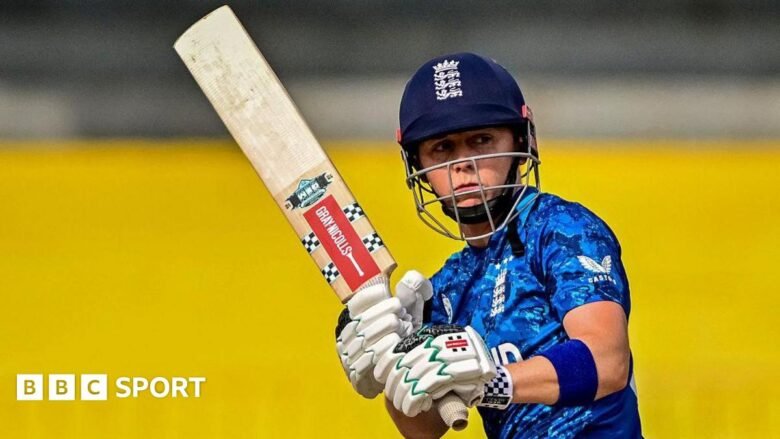
Heather Knight hopes this summer’s T20 World Cup on home soil can be transformative for women’s cricket in the UK after conceding success in 2017 was not fully capitalised on.
Knight, 35, captained England to victory in the 2017 showpiece event at Lord’s and is currently preparing for this year’s T20 tournament, which begins in 50 days’ time when England take on Sri Lanka at Edgbaston
“I think there probably wasn’t the structure in place to really maximise it in 2017,” Knight told BBC Sport.
“Obviously domestic cricket in this country wasn’t professional. We’re in a completely different place now. There is that real scaffolding and it’s a lot more normal to be a woman in sport, which is really exciting and hopefully we can capitalise on it a little bit more.”
In the nine years since 2017, Knight has seen the domestic game transform through the introduction of a professional domestic structure and The Hundred.
England, however, have not won an ICC trophy in that time. They reached the finals of the T20 and 50-over editions in 2018 and 2022 respectively but lost both to Australia, and were beaten by South Africa in the semi-finals of both the 2023 and 2025 tournaments.
In 2024, they failed to make it out of the T20 World Cup group stage after a defeat by West Indies but Knight hopes a recent revamp to the current county structure will pay off.
“I think we’ve seen that in this country over the last few years how investment and how having the right structures, [and] The Hundred, the domestic set-up is in a really good spot now. So if you get that right, the rest will follow,” Knight says.
“I think what it [2017] did do was change perceptions of what women’s cricket could be if it was done properly, if it was funded properly.”
The England and Wales Cricket Board’s Head of Strategic Growth, Gemma Barton, acknowledges the need to grasp the momentum of being hosts.
“We aren’t waiting until the tournament to find out if England win to see whether we can create legacy. From that point [2017] onwards, we have then started to see those foundations grow and that base build,” she explained.
“Last year, 24,000 women’s fixtures were held across England and Wales. So that growth has taken its time, but now we’re reaping the rewards of those great foundations from that strategy.”