On Wednesday afternoon, after reporting from several news outlets cast doubt over LIV Golf’s future, the league’s CEO, Scott O’Neil, sent his staff an email that later in the day made its way to reporters. The message read in part: “Our season continues exactly as planned, uninterrupted and at full throttle. While the media landscape is often filled with speculation, our reality is defined by the work we do on the grass.”
O’Neil was responding to reports from several outlets — including the Financial Times, New York Times and Wall Street Journal — that indicated LIV’s financial backer, the Saudi Public Investment Fund, was on the verge of pulling its funding.
Those reports came on the same day that the PIF announced a strategic shift for the next five years by which the fund said it would transition from “a period of rapid growth and acceleration to a new phase of sustained value creation, with a strengthened focus on maximizing impact, raising the efficiency of investments, and applying the highest standards of governance, transparency and institutional excellence.” (On Thursday, the PIF announced that it has sold off its 70 percent stake in the Saudi Pro League soccer club, Al Hilal.) The reports also came against the backdrop of the war in Iran, which has led to significant cuts in the Kingdom’s oil production, which largely funds the PIF.
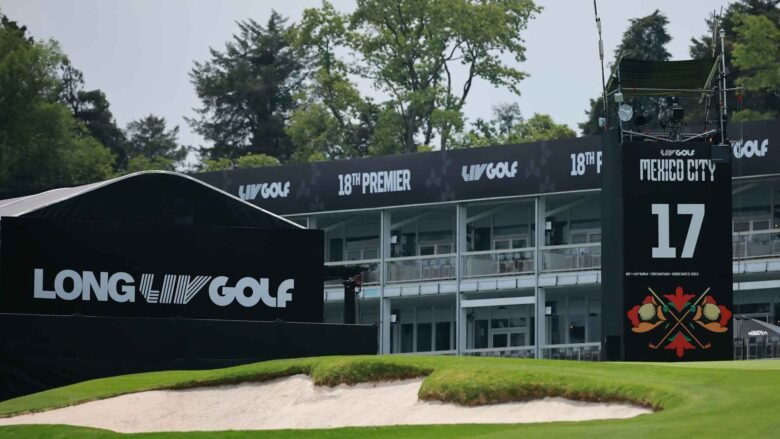
As the news buzzed around the golf world, Jon Rahm, Bryson DeChambeau and the rest of LIV’s players were in Mexico City for this week’s LIV event. An on-site source told GOLF.com that the scene at Club de Golf Chapultepec was “business as usual.” Rahm and his teammates played a practice round Tuesday. Tee times for Thursday’s opening round were released, right on schedule, and a pro-am played out on Wednesday. Asked in a press conference about the reports, Sergio Garcia said, “We haven’t heard anything other than what Yasir [Al-Rumayyan, the PIF governor] told us at the beginning of the year. That he’s behind us, that they have a long-term project. You know there are always a lot of rumors, and I can’t tell you anything more than what we already know.”
But behind the scenes, weighty discussions reportedly were afoot. According to James Corrigan of The Telegraph, LIV executives were summoned to LIV’s New York City offices Wednesday for an emergency meeting. One agent told GOLF.com he flew to Mexico City Wednesday morning in response to speculation about the intent of that meeting.
The Wednesday reports came just three days after the conclusion of the Masters, where O’Neil was in attendance and there was no indication on the grounds that LIV was facing such a crisis. In recent months, in fact, LIV appeared to have been gaining momentum with a wave of new sponsors and other corporate partners. Beginning this season, LIV players became eligible for Official World Golf Ranking points, creating more pathways for its players to qualify for the majors. Last month, in South Africa, the league conducted one of its most successful events to date. And earlier this year, Al-Rumayyan approved for LIV a $266.6 million capital injection.
The league also has shaken up and, in some ways, reinvented the upper rungs of the men’s professional game. The ubiquitousness of $20-plus million purses, the prevalence of team golf and increased importance of the major championships all are correlated with LIV Golf’s arrival.
But the league also has faced considerable challenges, beginning with its bottom line. Since its 2022 inception, LIV reportedly has posted losses climbing into the hundreds of millions. (On Wednesday, Golf Channel’s Rex Hoggard reported that several LIV players and vendors told him that they had not been paid “for the last few weeks”; LIV has not responded to GOLF.com’s inquiry on the matter.) The league’s viewership numbers have been light, particularly in the U.S. And a couple of the league’s stars, in Brooks Koepka and Patrick Reed, have moved on.
LIV and the PGA Tour have tried but failed to find a path forward together. After the leagues agreed to pursue a partnership in June 2023, discussions continued all the way to the White House in February 2025, where President Donald Trump hosted Tiger Woods, Adam Scott, Al-Rumayyan and PGA Tour commissioner Jay Monahan. While the meeting was publicly deemed “constructive,” it was one of the final, if not the final, times the sides would meet.
10 golfers (besides Rory McIlroy) who won the 2026 Masters
By:
Dylan Dethier
Much of the last year has been spent with each side going its own direction, with little talk of reunification. The Tour hired a new CEO, Brian Rolapp, and is taking an aggressive route to recreate itself with a new competitive structure based on fewer events with harsh promotion and relegation. LIV Golf pursued scale with its international events and occasionally found success, particularly in golf markets, like Australia and South Africa, that the PGA Tour has not visited for years. But a few key factors matter more than on-site attendance, namely how many events draw meaningful broadcast audiences and generate big-time sponsor interest.
LIV’s players are contracted to play 14 events annually. The league has settled into a yearly calendar where most of its first half of events are played abroad and its summer events in the States. In 2025, LIV saw big crowds at plenty of its domestic events, setting records in Chicago and Indianapolis last August. But hosting events in the winter and spring in far-reaching corners of the world has been challenging when it comes to attracting U.S. television audiences. The time-zone differential between, say, Saudi Arabia for the league’s season-opener, and the American East Coast, requires tee times be scheduled late to serve U.S. fans … or ignoring that audience all together.
As GOLF.com’s James Colgan reported last spring, the Tour has out-rated LIV repeatedly by a scale of 10x to 11x. For any number of reasons — like the decades-old viewing habits pushing golf fans to CBS and NBC, not FOX Sports — golf viewers have not tuned in to LIV competition like they have for other pro events. Considering that more than half of the PGA Tour’s core revenues are tied up in television rights, similarly to other major pro sports leagues, the value LIV could accrue from a small TV audience was a glaring void on its profit and loss sheet.
Despite that, LIV continued to spend lavishly to host its tournaments. From its debut event — outside London in 2022 — it was clear that few costs had been spared in building its futuristic fan village, locking in courses and, most important, paying for talent. Those expenditures continued to this day, with LIV landing superstar DJ Calvin Harris’s first-ever performance on the African continent.
The cost of creating mega-wattage events with massive musical acts and building out a different version of what golf tournaments could look like has not been cheap. According to business filings in the United Kingdom, LIV’s international events business incurred losses of more than $460 million in 2024 alone, and north of $1 billion over the last four years. LIV’s rate of loss had slowed in recent the years, but O’Neil explained to the Financial Times in early 2026 that he didn’t see the league turning a profit in the next five years, or maybe even 10 years. And yet, the money always been there. Business filings in the U.K. show steady capital support from LIV’s backers.
If the PIF does divest from LIV, the league will, of course, need new investors to stay operational beyond this season. One path forward could be selling minority ownership stakes in LIV teams, which earlier this year league officials and players said was a possibility. Partnering with another tour or tours might also be an option.
This week marks LIV’s sixth event of its 2026 season. Next on the schedule is the league’s first U.S. tournament of the year, at Trump National Golf Club in Virginia, from May 7-10. The following week, LIV’s top players will convene in Philadelphia for the PGA Championship at Aronomink.