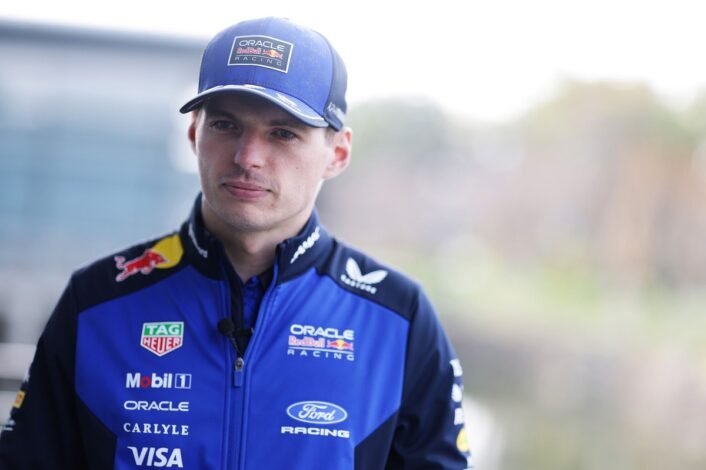
After the first race under the new regulations, Formula 1 highlighted the number of overtakes on its social media channels. The season opener produced a total of 120 overtaking moves, roughly three times the number from the year before. The drivers, however, were not particularly impressed, with Max Verstappen stressing in Shanghai that such figures say very little.
“Sometimes you have safety cars, virtual safety cars, so you can never say: now there were 120 overtakes and then 60. It depends on how the race unfolds. It’s not black and white that more is always better. You also have to look at how those overtakes actually happen,” the Red Bull driver explained.
“Of course in the beginning, the first 10 laps, some people had very little battery and others had more. Some people had to come from further back, like I did, so then you automatically get more overtakes. Some cars retired as well, so you can always find something in those numbers.”
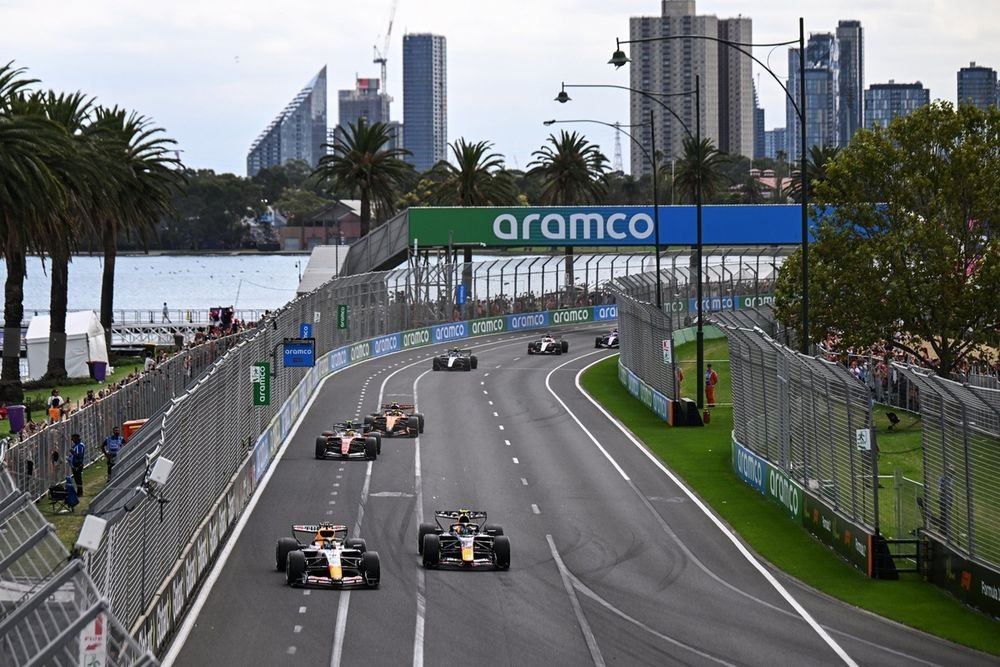
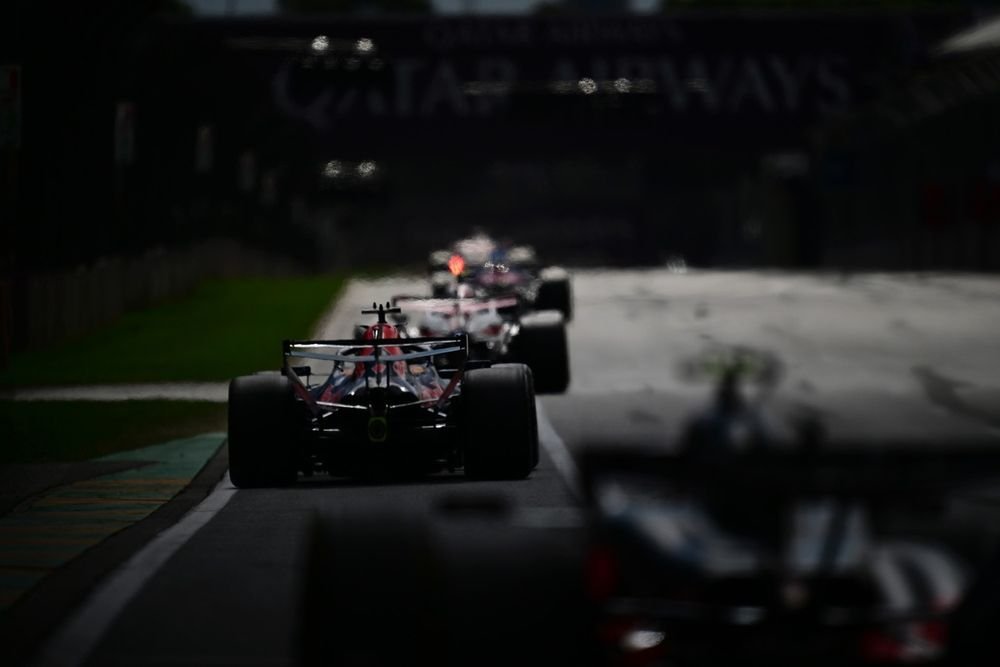
According to most drivers, Melbourne was simply a matter of flying past each other on the straights, depending on how and where drivers deployed their electrical energy. Most overtakes were completed well before the braking zone, meaning there were few wheel-to-wheel battles into the corners. Overtakes such as Oscar Piastri’smove around the outside of Lewis Hamilton in Australia a year earlier were absent.
The FIA had said beforehand that it wanted to calibrate the strength of overtake mode accordingly, but in reality the on-track picture had more to do with the use of boost mode, with overtake mode itself having only a minor effect according to the drivers. Most overtakes came from different ways of deploying the electrical energy, something Oliver Bearman summed up with an amusing anecdote: “I was like, I guess I’ll try this boost button, and see how it works. And then I was just flying past everyone on the straights, so it was quite funny. It was like I was in F1 and everyone else was in F2. But then, of course, you have to recharge the battery again, because otherwise you’re dead into the next straight.”
Where DRS overtakes were sometimes considered too easy, this set of regulations has taken things to a more extreme level. Lando Norris described the racing with the 2026 cars as “even worse” than a qualifying lap and called the overall picture “way too artificial”.
Lando Norris, McLaren, Max Verstappen, Red Bull Racing, Oliver Bearman, Haas F1 Team
Photo by: Andy Hone/ LAT Images via Getty Images
In the paddock the reigning world champion has received support from the vast majority of drivers, including Sergio Perez. The experienced Mexican has gone through several rulesets in his F1 career, but described this one as overly artificial during Shanghai media day: “I found it very fake, to be honest. It’s all just under a button. You overtake and then you get overtaken, Mario Kart-style.”
It has resulted in what is referred to in the paddock as yo-yo racing. A driver uses a (large) portion of the 350kW of electrical power to complete an overtake, but then runs out of battery, allowing the rival to strike back on the next straight. Officially that counts as two overtakes, but according to the drivers it is not what pure racing should look like.
“It’s not only about the overtake anymore. The overtake is not enough,” Charles Leclerc said. “You need to think about how can you get past the car using the least energy possible, and so it’s an added complexity.”
Two factors made the season opener look worse
The follow-up question, of course, is whether the entire F1 season will turn into yo-yo racing, or whether Albert Park simply exaggerated the phenomenon. Alpine driver Franco Colapinto believes it is the latter, given the layout with fast sections that follow each other quickly and the difficulty of recharging the battery due to the lack of heavy braking zones.
“I think Melbourne is a much more exaggerated track for these situations because we are so poor on energy. I think as the tracks get harder braking and not so much high speed, it’s going to be easier on the energy and we are going to see this less of it,” the Alpine driver said.
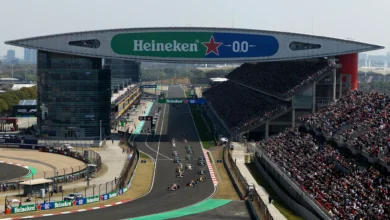
For exactly that reason it should be significantly better in Shanghai, despite the enormous 1.2-kilometre straight. “I think here it’s going to be much easier to harvest [energy] with a lot more braking zones, a lot more slow corners,” Piastri agreed. “I think it’s more difficult at circuits that are higher speed in nature or just have very long straights.”
Isack Hadjar, Red Bull Racing, Arvid Lindblad, Racing Bulls
Photo by: Sam Bagnall / Sutton Images via Getty Images
A second aspect is that teams and drivers are still learning about these new regulations. While the race in Melbourne produced many unnatural situations, Leclerc pointed out that something similar – albeit to a lesser extent – also happened at the start of the previous ruleset.
“Honestly in the past, I think we were doing that in more specific scenarios. I remember the battle with Max in Jeddah 2022, where we were both doing strange things on braking to be behind at the DRS detection point. So these were the kind of games that you were also playing in the past for different reasons. Now, obviously, it’s for a completely different topic and something you do much more regularly.”
In terms of energy management, drivers seemed to gradually converge on a similar strategy. That was visible during the second half of the Australian Grand Prix. While the opening laps were a learning process for everyone – as Bearman described with the boost button – things stabilised in the second half. As the season progresses, that trend should continue.
Verstappen discusses potential improvements with the FIA
Nevertheless, not all drivers are convinced that racing will improve significantly as more time passes. “It’s more of a Melbourne thing, yes, but this is still the trend. It’s going to be like this this year,” Isack Hadjar said when asked by Motorsport.com.
It means most drivers are still keen to see changes, for instance after the evaluation the FIA has scheduled following the sprint weekend in China. “Well, I hope it won’t be like this all year,” Verstappen said. “It depends a bit on the circuit, but it also depends on how the battery can be used. If you ask the drivers, I don’t think anyone really enjoys how it comes about at the moment.”
For that exact reason Verstappen has shared several ideas with the FIA – plans to make the racing better – although it should be noted that most of his proposals are aimed at the longer term.
Max Verstappen, Red Bull Racing
Photo by: Mario Renzi / Formula 1 via Getty Images
“For this season it will be quite difficult,” Verstappen admitted. “Hopefully for next season we can still change a few things, but those would probably be bigger changes. For this year you need to try and reach somewhat normal top speeds. If that has to be done with a bit less battery power, then so be it, I think. But those are all things they’re looking at.
“I also think we need to move away from lifting in qualifying at certain circuits, which just makes no sense. Basically it punishes the driver who wants to go the fastest. Because if you look at the past years, on average the fastest drivers are the ones who spend the most time on the throttle over a lap. And now that works against you.”
When it comes to improving the situation in the short term, both the deployment side and the harvesting side can be looked at. Regarding the latter, McLaren tested super clipping up to the full 350kW during the final day of testing in Bahrain. That reduced the need to lift, but still produces the same visual effect for fans, as the cars lose speed on the straights while the driver is flat out, which still gave the odd look, which Verstappen agreed with: “Yes, so for me that’s a slightly worse option.”
According to the four-time world champion it would be better to reduce the share of electrical power, at least in race trim. This would lead to less lift-and-coast and super clipping, but it would come at a cost. To begin with, it would move further away from the near 50-50 split, and secondly it would result in slower lap times.
“Yes, but they should have thought about that earlier, right?” Verstappen responded. “In the end, you just need somewhat normal speeds, so that you’re not always dependent on lifting and that you can just drive naturally again. We need to move away from that [lifting].”
Asked whether these proposals are supported by multiple teams or whether they are mainly Verstappen’s own ideas that he has presented to the FIA, he replied: “Most of it comes from me, in terms of what I think would be better. In the end what I’m suggesting is better for everyone, because it just improves the racing. It’s not about what I want – it’s about what’s better for the sport.”

Max Verstappen, Red Bull Racing
Photo by: Dom Gibbons / Formula 1 via Getty Images
The final question, however, is whether such proposals stand any chance of success, given that they could disadvantage teams that are particularly strong in energy management – most notably Mercedes and Ferrari.
“Some people are happy with the rules now because they’re fighting at the front. So you always have to take that into account. Some will say: ‘I’m actually fine with it’, because they’re leading at the moment. On the one hand I understand that. But on the other hand you also have to think about the sport, because if you have seen everyone getting out of the car in Australia, I didn’t see many happy faces, to be honest.”
We want to hear from you!
Let us know what you would like to see from us in the future.
Take our survey
– The Autosport.com Team