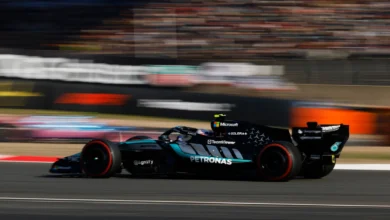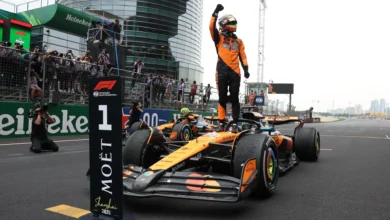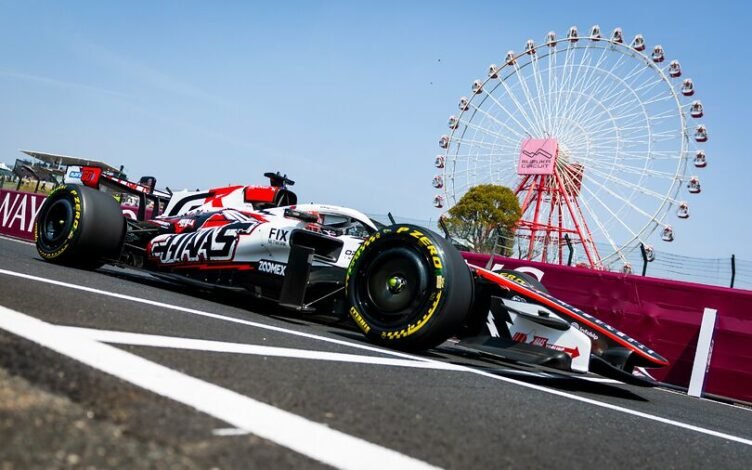
The FIA has moved to clarify its position on potential rule adjustments for the 2026 Formula 1 regulations following Ollie Bearman’s heavy crash in Japan, confirming that a structured review process is already underway and that multiple meetings will take place throughout April.
Haas Formula 1 driver Ollie Bearman has given his first reaction after crashing out of the Japanese Grand Prix in a violent accident that registered 50G, ending his race on lap 22 at Suzuka’s high‑speed Spoon Curve.
Bearman had been fighting Franco Colapinto for 17th place when he approached the Alpine with a significant speed differential. As he closed rapidly on the Argentine rookie, Bearman swerved onto the grass in an attempt to avoid contact — a split‑second decision that immediately sent his Haas out of control.
The overspeed was substantial enough that Bearman’s car snapped sideways the moment it touched the damp grass, firing him across the runoff and into the barriers at high velocity. The impact measured 50 times the force of gravity, one of the largest recorded crashes of the 2026 season so far.
Despite the severity of the accident, Bearman was able to climb out of the wreck unaided, though he was visibly limping as he walked away. Medical checks later confirmed bruising to his right knee, but crucially no fractures.
The crash came during a difficult race for Haas, with Bearman attempting to recover after a challenging opening stint. His pace relative to Colapinto — the “significant overspeed” that triggered the evasive move — was a direct consequence of differing energy deployment patterns, a recurring theme in the early phase of the 2026 regulations.
The incident also contributed to the broader safety debate that has intensified in recent weeks, prompting the FIA to schedule multiple meetings in April to review the 2026 power unit and energy‑deployment rules.
The governing body stressed that discussions around the new rules have been ongoing since long before the season began. As the FIA explained: “Since their introduction, the 2026 regulations have been the subject of ongoing discussions between the FIA, Teams, Power Unit Manufacturers, Drivers and FOM.”
A key feature of the new regulations is their flexibility, particularly in how energy deployment is managed. The FIA highlighted this built‑in adaptability: “By design, these regulations include a number of adjustable parameters, particularly in relation to energy management, which allow for optimisation based on real-world data.”
Crucially, the FIA emphasised that all stakeholders had already agreed to a formal review once enough racing data had been collected. “It has been the consistent position of all stakeholders that a structured review would take place after the opening phase of the season, to allow for sufficient data to be gathered and analysed.”
That review will now begin in earnest. “A number of meetings are therefore scheduled in April to assess the operation of the new regulations and to determine whether any refinements are required.”
However, the FIA made clear that any changes — particularly those involving energy deployment, which has been a major talking point among drivers — cannot be rushed. “Any potential adjustments, particularly those related to energy management, require careful simulation and detailed analysis.”
Safety, the FIA reiterated, remains the foundation of its decision‑making. “The FIA will continue to work in close and constructive collaboration with all stakeholders to ensure the best possible outcome for the sport and safety will always remain a core element of the FIA’s mission.”