

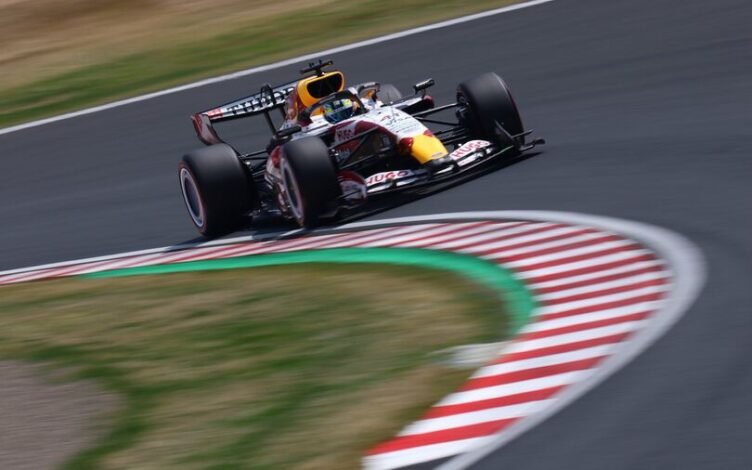
Pirelli’s work in Japan is far from over. Following last weekend’s Japanese Grand Prix, the Italian manufacturer has remained at Suzuka for a two‑day private test with Red Bull and Racing Bulls, a crucial session in the development programme for the 2027 Formula 1 tyres.
The test, scheduled for Tuesday and today, has taken on added importance after the cancellation of two earlier sessions in the Middle East. Political instability in the region forced the scrapping of both the wet‑weather test planned in Bahrain and the dry‑tyre session originally set for Jeddah.
Losing those opportunities compressed Pirelli’s schedule and shifted a significant portion of the workload onto the Suzuka outing.
One major advantage of this week’s programme is the use of 2026‑spec cars rather than the older mule chassis typically employed for tyre development. With the new regulations now fully in effect, running current machinery gives Pirelli far more representative data—especially regarding load profiles, aerodynamic behaviour, and the evolving performance window of next‑generation cars.
Each team’s participation counts as a full test day under the sporting regulations, meaning Red Bull will run one day and Racing Bulls the other. With only 40 test days available across the entire season—and a calendar packed with back‑to‑back races—sessions held immediately after a Grand Prix have become essential for logistical efficiency.
Focus on construction and harder compounds
The primary objective at Suzuka is to continue refining the construction of the 2027 tyres. The current prototype is in the “fine‑tuning” phase, and Pirelli needs to ensure the structure can withstand the rising aerodynamic loads expected as teams develop their 2026 and 2027 cars. Historically, the early years of a new technical cycle see rapid performance gains, and tyre robustness must evolve accordingly.
Suzuka is an ideal venue for this type of work. Even with the new, grippier asphalt laid for the 2026 race, the circuit remains one of the most demanding on the calendar, with long, high‑energy corners that punish the tyres—particularly the fronts.
Alongside construction testing, Pirelli will also evaluate new compounds for the C1, C2, and C3—the hardest trio in the range and the same selection used during the Grand Prix weekend. Although the race itself did not produce notable graining or excessive degradation, the manufacturer wants to explore alternative formulations that could offer improved consistency or durability under extreme load.
The loss of the Bahrain wet test is particularly significant, as the cancelled session would have used an artificial irrigation system to create consistent wet conditions—something difficult to replicate elsewhere. Without it, Pirelli must reorganize its wet‑tyre development later in the year, adding further pressure to an already tight schedule.


