Formula 1 has always been a sport of extremes — speed, precision, and relentless innovation. But over the past two decades, one metric has quietly ballooned: weight. F1Technical’s senior writer Balazs Szabo explains how the F1 weight limit has evolved over the past two decades.
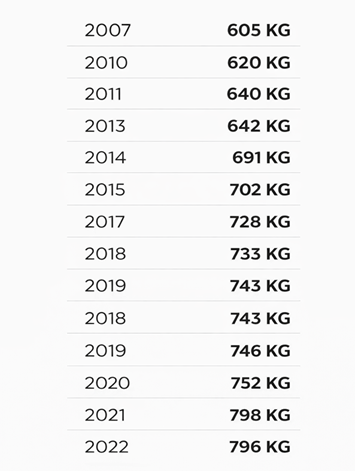
From the lithe 605 kg machines of 2007 to the nearly 800 kg behemoths of 2023, F1 cars have gained almost 200 kg. Now, in 2026, the FIA has finally reversed the trend, ushering in a new era of lighter, more agile racers.
The journey began in 2007, when F1 cars weighed just 605 kg. These were compact, high-revving V8 machines with minimal hybrid components and a focus on mechanical grip. But as safety standards rose and hybrid technology entered the fray, the scales began to tip.
By 2010, the minimum weight had increased to 620 kg, and by 2011, it reached 640 kg — driven largely by larger fuel tanks and reinforced structures.
A seismic shift came in 2014 with the introduction of turbo-hybrid power units. The minimum weight jumped to 691 kg, a staggering 49 kg increase in a single season.
From there, the upward trend continued: 702 kg in 2015, 728 kg in 2017, and 752 kg by 2021. Wider tyres, larger chassis, and the addition of the halo device all contributed to the bulk.
The 2022 regulations brought another leap. Ground-effect aerodynamics required heavier floors and more robust safety structures, pushing the minimum weight to 798 kg.
Although 2023 saw a slight dip to 796 kg, the cars remained far heavier than their predecessors — and many fans and drivers began to voice concerns about agility, tyre wear, and racing dynamics.
Several factors contributed to this weight gain. Hybrid systems introduced batteries, MGU-K units, and complex control electronics. Safety innovations — from stronger crash structures to the halo — added mass.
Aerodynamic demands led to larger wings and floors, while the switch to 18-inch wheels in 2022 increased unsprung weight. While these changes improved sustainability and safety, they also made cars less nimble and harder to follow.
What has changed for this year?
Recognizing the need for change, the FIA introduced sweeping reforms for 2026. The minimum weight has been reduced to 768 kg, down from 800 kg. The maximum wheelbase has been shortened by 200 mm to 3.4 meters, and the floor width narrowed by 100 mm to 1.9 meters.
Pirelli tyres are slimmer too — 25 mm narrower at the front and 30 mm at the rear. These changes, combined with a more compact hybrid system, aim to restore agility, improve racing dynamics, and reduce energy consumption.
The 2026 regulations mark a philosophical shift. F1 is no longer chasing raw power at any cost; it’s seeking balance. Lighter cars mean better cornering, more responsive handling, and closer racing. They also open the door to more creative engineering, as teams strive to hit the weight limit without sacrificing performance.