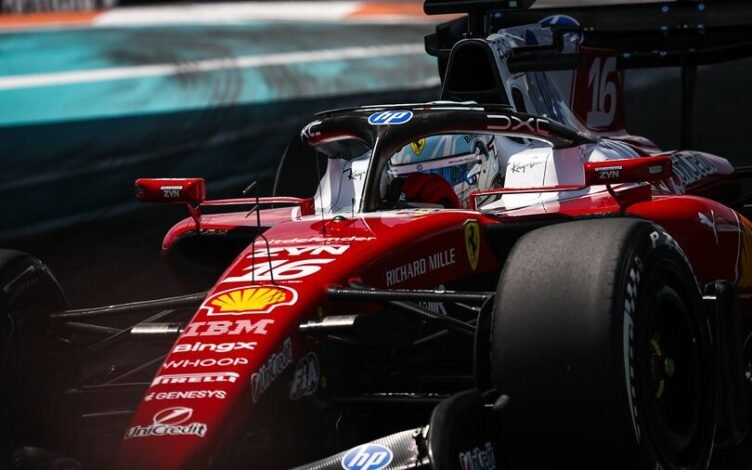
Charles Leclerc’s dramatic spin on the final lap of the Miami Grand Prix was not the result of misfortune or external interference but a direct consequence of a calculated attempt to reclaim third place from Oscar Piastri on tyres that no longer had the grip to support such aggression.
The Ferrari driver openly acknowledged his responsibility for the incident, stating that he was “very disappointed with myself. The last lap mistake is all on me and it cost us P3 or P4, more likely it would have been a P4 but the P3 was still right there.” His self‑criticism matched precisely what the telemetry revealed.
Leclerc’s race had already been a complex blend of highs and lows. After starting third, he executed an excellent launch that allowed him to overtake both Kimi Antonelli and Max Verstappen into Turn 1. Although he briefly led the race, he was soon shuffled back during the early‑lap battles with Antonelli and Lando Norris.
An early pit stop dropped him behind George Russell, forcing him into a recovery phase that included retaking the position from the Mercedes and later overtaking Verstappen. By the closing stages, Leclerc had stabilised himself in third place, only to lose the position to Piastri on the penultimate lap down the back straight.
Determined to respond immediately, Leclerc prepared a counter‑attack for the final lap. The telemetry from the final three laps — particularly the comparison between Lap 56 and Lap 57 — illustrates the strategic intent behind his approach. The speed trace shows that he deliberately reduced his entry speed into Turn 2 on the last lap.
This was not a mistake but a conscious attempt to widen the radius and maximise the exit of Turn 3, giving him the best possible acceleration window to challenge Piastri on the following straight.
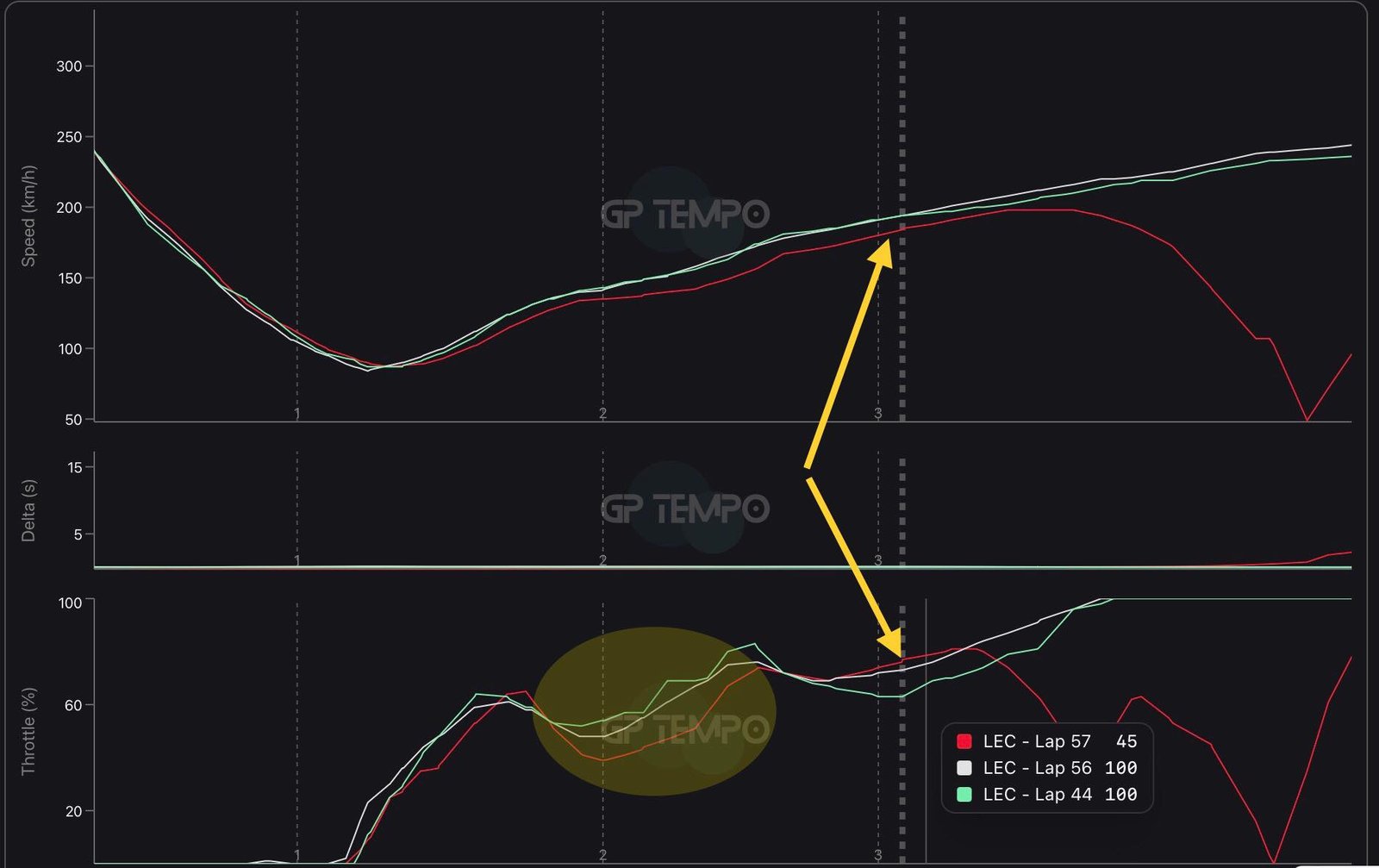
However, the throttle trace exposes the decisive factor in the spin. On Lap 57, Leclerc applied the throttle earlier and more aggressively at the apex of Turn 3 than he had on the previous lap.
The yellow‑highlighted region in the telemetry makes the correlation unmistakable: the car received a sharper torque demand at a moment when the rear tyres — heavily worn after 57 laps in hot Miami conditions — no longer had the mechanical grip to translate that input into forward motion.
The rear stepped out instantly, sending the Ferrari into a high‑speed spin across the exit kerb. Although Leclerc managed to avoid a full impact, the left‑hand side of the SF‑26 brushed the wall, causing minor damage that left him unable to defend against Russell and Verstappen in the final corners. He crossed the line in sixth place.
Leclerc did not shy away from the responsibility. “I’m very disappointed with myself, mistakes happen but on the last lap of the race like that, it’s frustrating and not the level where I should be at,” he admitted afterwards.
He also reflected on the broader context of his season, adding that “it’s been a very strong start to the season, not many mistakes. This one luckily didn’t cost us too many points but it could have ended in the wall. It’s a shame.”
The telemetry confirms the accuracy of his assessment. The spin was not caused by setup imbalance, external pressure, or misjudged positioning by another driver. It was the direct result of a deliberate attempt to engineer a better exit from Turn 3 by sacrificing Turn 2, followed by a throttle application that exceeded the available grip of tyres that had already given everything they had.