AUGUSTA, Ga. — As the sun peeked out from behind the clouds, improving the lighting on a cinematic Masters finish, two turtles crawled out of the pond guarding Augusta National’s 15th green.
They settled on the bank and that’s where they stayed, unmoving and unmoved, as the final pairings of the world’s greatest golf tournament played past. They seemed unimpressed by Scottie Scheffler’s birdie and its accompanying roar. Unaffected by the final birdie in Justin Rose’s valiant, heartbreaking charge. Unbothered by Sam Burns’ second shot, which rolled back into the pond, or his fourth, which sailed over their shells and set up an impressive up-and-down par.
But as Rory McIlroy crested the hill and looked over the pond and stepped up to an awkward, high-stakes wedge-shot approach in the final twosome of the day, I couldn’t help but think that the turtles were the only ones unaware of what was at stake.
THIS WEEK WAS SUPPOSED TO BE a victory lap for McIlroy. A year ago, same time and place, he slayed the dragon, climbed the mountain, lifted the weight of the world from his shoulders. This week he returned as a career Grand Slam winner, which meant for the first time in a decade and a half he could show up expectation-free. He even kept his golf game under the radar, withdrawing with a back injury at Bay Hill and slogging to T46 at the Players before sitting out the next three weeks as others gathered attention in his absence.
But then he arrived, and teed off, and did something foolish: He jacked up expectations again. He played a Friday afternoon stretch of golf so brilliant that he took a six-stroke lead to the weekend. Suddenly there was something to lose, something at risk in his victory lap. If he held on to win, it would validate everything he’d done the year prior. A blown lead, on the other hand? That would dig up more of the stuff the win was supposed to have buried.
Then McIlroy yielded his lead on Saturday, giving back all six strokes to the field. He was the lone remaining figure on the range that night, firing balls into the setting sun, looking again like a man trying to find something important. He entered Sunday tied atop a star-studded and suddenly crowded leaderboard, and when he stumbled out of the gate, three-putting from five feet at No. 4, he was no longer atop the leaderboard.
But then he did what he does, roaring back with brilliant approaches at 7 and at 8 and — perhaps best of all — at 12, setting up birdie each time, regaining the lead as competitors faltered around him. Once he birdied No. 13 he led by three. Now the tournament was his to win or, if you’re the glass-half-empty type, his to give away.
And so, as he stepped up to that wedge shot at No. 15, everything was suddenly at stake. All week he’d said he was trying to channel the freedom he’d unlocked a year before, the freedom of already winning this tournament. He didn’t mention the flip side: the scar tissue that comes with nearly giving it away.
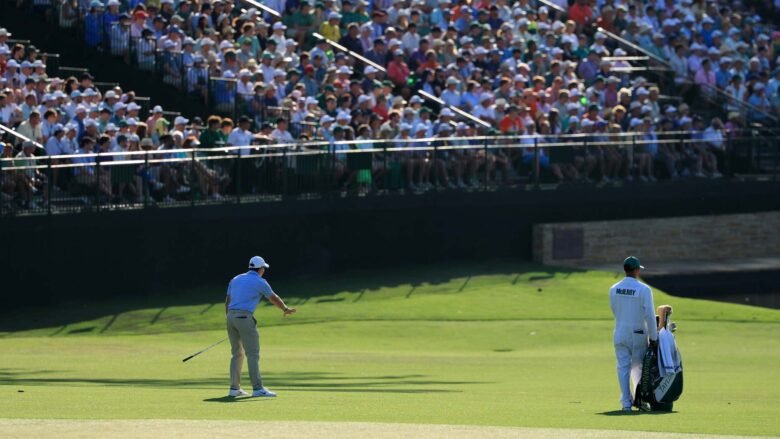
A year before, this is where it all went wrong, with a wedge shot into a second-nine par 5. He laid up to a perfect number that time, and he laid up to a perfect number this time, 107 yards. Downwind and downhill it was an ideal three-quarter lob wedge, McIlroy said later. But this is arguably the most notorious wedge shot in golf, off a downslope to a firm green with water short and trouble long. Which would win out: freedom or scar tissue?
“I tried to pitch it like 100, seven or eight paces short and just let it skip up, which is a perfect three-quarter lob wedge for me with that little bit of help [wind],” he said.
But it’s tough to judge contact off that lie and it’s tough to judge how wind will help a wedge. And so, as McIlroy’s ball came off his club and flew through the air, the crowd saw its trajectory and gasped — everyone along the 15th fairway and those in the greenside grandstands and those on the hillside overlooking the adjacent 16th. It wasn’t flying far enough.
“Sometimes if you’re going off a downslope, [15] is in a little bit of a valley area, and with wedge shots in particular with the wind, instead of the wind carrying the ball, it sort of knocked it down, and it didn’t carry anywhere near as far as it needed to,” McIlroy said later.
He was half-right. It didn’t carry as far as he intended it to. Not as far as he wanted it to. But it carried exactly as far as he needed it to, just barely, landing on the front right corner of the green, skipping forward and, as the crowd held its collective breath, settling there.
“Thankfully it hung up,” McIlroy said. “It was pretty close to coming back into the water. Thanking my lucky stars with that one.”
The tournament wasn’t technically over, but the peril lay behind him. He walked to 16 with a two-shot lead and the crowd walked with him, willing him to a par there and another at 17, allowing him the latitude to walk off with a bogey at the 18th.
And now it doesn’t matter, the wedge shot that barely carried. It doesn’t matter because it did carry. It ceased to matter as he tapped in on the 18th green, as he thrust his arms into the sky, as he hugged the people that matter most at the tournament that means the most.
His parents were there, behind the green, where he’d felt their absence last year and felt their embrace this time around. So were his wife, Erica, and his daughter, Poppy. And at the end of a long, teary, triumphant walk, there were his friends, his peers, Tommy Fleetwood and Shane Lowry and their caddies and their families and Augusta National members. And as they embraced him, one after the next, a swarm of patrons stayed gathered just beyond the ropes, taking in the scene, desperate to soak up the final rays of sun and the final moments of this Masters, all of them grateful to have this proximity to joy, to dreams, to greatness.