Hot on the heels of Mercedes double victories in the opening two rounds of the 2026 F1 season, F1Technical’s senior writer Balazs Szabo ponders about the variety of opportunities Mercedes might exploit with their rumoured sizeable power unit advantage.
Formula One has entered a transformative era in 2026, with the sport having prepared for its most significant power unit overhaul since hybrid engines were introduced in 2014. The new regulations has fundamentally rebalanced how performance is generated, shifting from the roughly 80:20 split between internal combustion and electric power to an even 50:50 ratio.
To achieve this, the complex MGU‑H — the heat‑recovery system that has been central to hybrid F1 engines for over a decade — has been removed entirely. In its place, the MGU‑K has become dramatically more powerful, rising from 120 kW to 350 kW, while total energy recovery per lap will increase from 2 MJ to 9 MJ.
Fuel flow has dropped from 100 kg/h to around 75 kg/h, and the sport has transitioned to advanced sustainable fuels, placing a premium on combustion efficiency and energy density. Despite these sweeping changes, peak power has remained above 700 kW, but how that power is delivered — and how consistently — will define the competitive landscape of the next era.
Within this context, rumours have emerged suggesting that Mercedes may have found a meaningful advantage in the internal combustion engine portion of the 2026 power unit.
The figure being discussed is around 10 kW — roughly 13 horsepower — and while that may seem small in isolation, the structure of the new regulations means such an advantage could be disproportionately valuable. The key lies in the fact that electric power, no matter how powerful, is temporary.
The MGU‑K’s 350 kW output can only be sustained for a limited portion of the lap before the stored energy is depleted. Once that happens, the car relies solely on the combustion engine. A stronger ICE therefore provides a constant performance baseline, ensuring superior acceleration and higher average power even after ERS deployment fades.
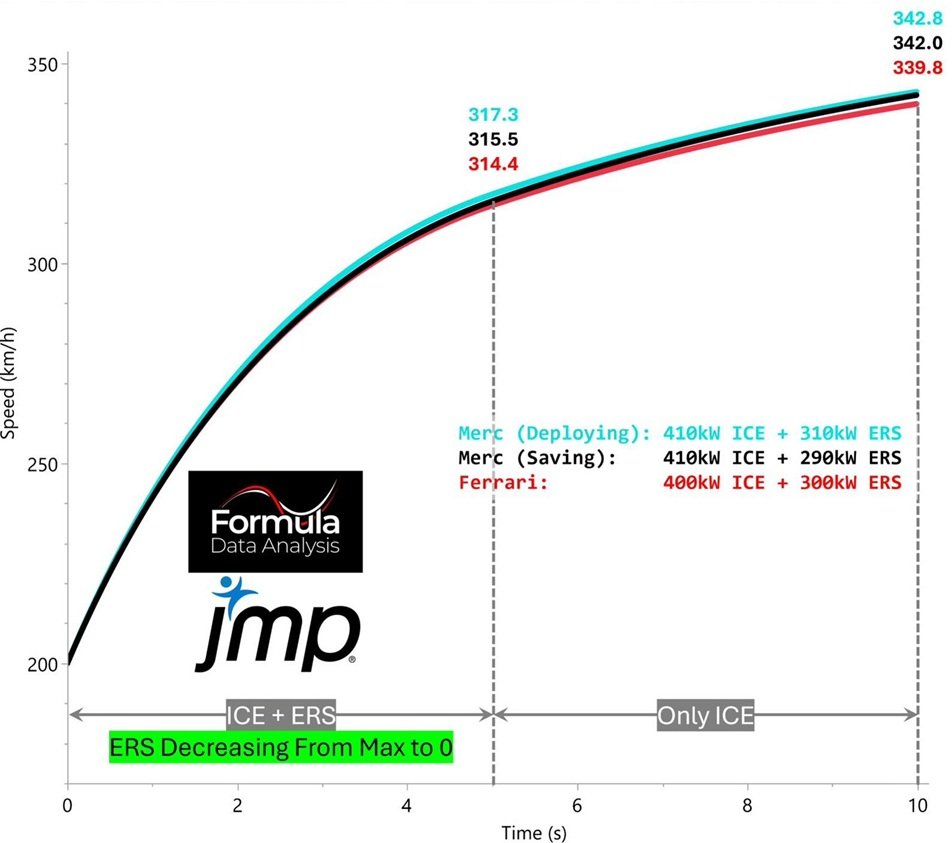
This opens the door to strategic possibilities that could give Mercedes a tangible on‑track edge. With a stronger ICE, the team can choose to deploy 10 kW less ERS on one lap, effectively “saving” energy without sacrificing performance, because the combustion engine compensates for the reduced electric boost.
Even in this energy‑saving mode, simulations suggest the Mercedes would remain faster than a rival such as Ferrari, whose ERS output diminishes over time while the ICE power remains fixed.
On the following lap, Mercedes could then deploy the energy saved previously, combining the inherent 10 kW ICE advantage with an additional 10 kW of ERS deployment. This creates a double‑benefit attack phase that rivals cannot easily match.
Beyond lap‑to‑lap tactics, a stronger ICE also allows Mercedes to run higher downforce levels without suffering a straight‑line speed penalty. The extra combustion power offsets the drag, enabling better cornering performance, improved tyre management, and more consistent race pace.
The removal of the MGU‑H amplifies all of this. Without the heat‑recovery system to smooth out energy delivery and maintain deployment, teams face greater variability in power output over the course of a lap.
This makes the constant, reliable contribution of the ICE more important than at any point in the hybrid era. A small combustion‑engine advantage becomes magnified, influencing not just peak performance but the rhythm and strategy of racing itself.