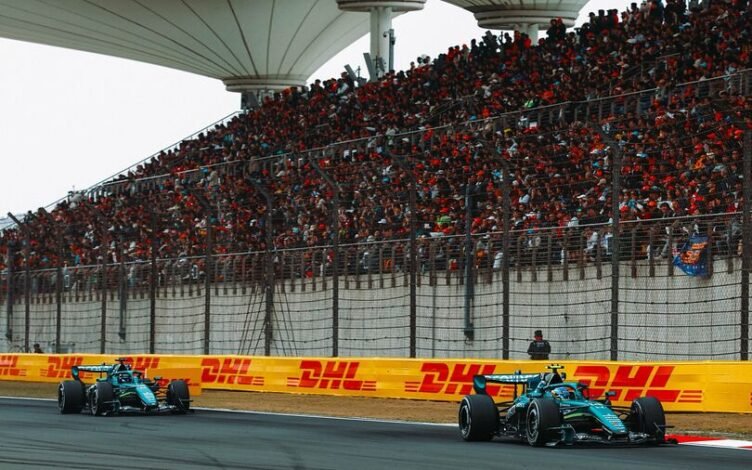
Aston Martin left the 2026 Chinese Grand Prix with mixed emotions: no points on the board, but an improved reliability after the turbulent start at the season-opening Australian Grand Prix.
While the team’s double DNF was far from ideal, the weekend did offer signs of incremental progress—particularly in mileage, reliability across the Sprint format, and early‑session performance.
The headline, however, remained the same: vibrations continue to be the defining limitation of the AMR26 and its Honda power unit.
Compared to the disastrous outing in Melbourne, Aston Martin managed to complete significantly more running in Shanghai. Honda trackside manager and chief engineer Shinato Orihara highlighted this as a key positive: “We cannot be satisfied with the double DNF in the Chinese Grand Prix.
“However, if we focus on the more favourable areas, we ran more miles than in Melbourne, which is encouraging. We also increased our reliability throughout the Sprint weekend, but this isn’t yet enough to complete the full race distance.”
The team had entered the weekend with cautious optimism. Honda had made targeted changes to reduce the severe vibrations that plagued the opening round, and early feedback suggested some improvement. But the gains were not enough to prevent the issue from resurfacing in the race.
Orihara acknowledged the progress—but also the scale of the task ahead: “We have improved the vibrations on the systems side, but it’s still an issue for driver comfort. This is a key area to address as we look ahead to the next race in Japan.”
Why did Alondo retire from the Shanghai race?
Fernando Alonso’s race ended after 35 laps, when the physical strain from the vibrations became too severe to continue. The two‑time world champion described an alarming loss of sensation: “It was difficult today. We found more vibrations than in any other session on the weekend.
“So, physically, I could not continue much longer. I started to lose the feeling of my hands and my feet, so it was not a nice feeling.”
Alonso had been battling the issue from early in the race: “From about lap 20, I was struggling with the vibration levels, and we were already one lap down, so in the end, we decided to retire the car.”
His withdrawal echoed pre‑race warnings from Adrian Newey, who had cautioned that prolonged exposure to such vibrations could risk “nerve damage”—a concern that clearly influenced the team’s decision to stop the car.
Lance Stroll’s race ended even earlier, retiring on lap nine with a separate technical issue. Honda and Aston Martin are still working to identify the cause.
Orihara emphasized the urgency of the investigation: “As for Lance’s DNF, we are currently investigating the root cause, and work will continue with HRC Sakura, together with Aston Martin, to understand what happened on the ninth lap.”
The radically new 2026 regulations have created a steep learning curve across the grid, with multiple DNFs and DNSs in Shanghai alone. Orihara acknowledged the complexity of the new era—but refused to use it as a shield:
“The 2026 regulations are far from simple, as shown by the number of DNFs and DNSs today. We know this isn’t an excuse for our reliability and performance, and we will strive to improve. We have more work ahead of us, and that is our priority right now.”