Over the years, a select group of Formula 1 drivers have left their mark on the sport by becoming something of a cult hero. The reasons for earning such a tag can vary; perhaps they pulled off an against-the-odds result, had a driving style that made them a hit with fans, or coupled their on-track exploits with a memorable personality off it.
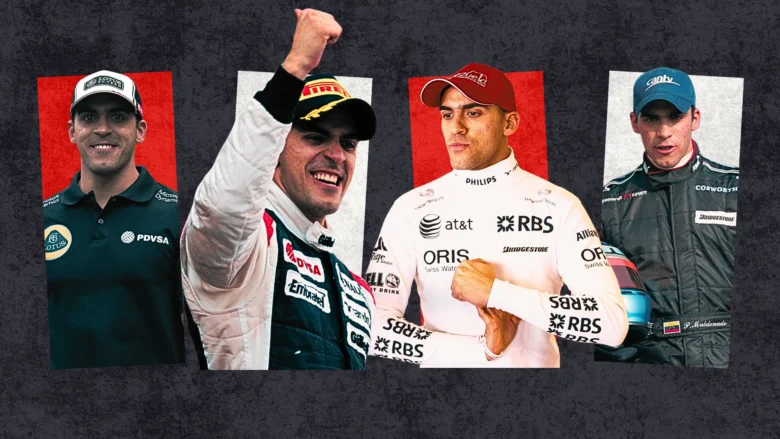
One name that has frequently been attached to the label – and ticks all of the above boxes – is Pastor Maldonado. While he only competed in the sport for five seasons, the Venezuelan remains a popular figure amongst fans thanks to his determined approach to racing and an unforgettable underdog victory.
In the first of our Cult Heroes features, F1.com chats to Maldonado about his time in Formula 1, the roots of his passionate driving style, and how it feels to still be a cult hero to fans – both old and new – more than 10 years after his last race…
Arriving in F1 after a ‘very tough’ early career
“I think the most valuable thing is the people surrounding Formula 1, from the fans to the team principals and drivers, but also all the team members,” says Pastor Maldonado as he reflects on how current-day F1 compares to his own stint in the sport.
“When the teams are looking for mechanics, technicians, engineers, they are the best, and the best not only in terms of quality but in terms of passion, because what runs Formula 1 is the passion. And I think this passion didn’t change from my time to today.”
It seems a fitting statement for a driver known for his spirited approach to racing during his five years in Formula 1, the now 41-year-old having spent three campaigns with Williams between 2011 and 2013 before a two-season stint for the Lotus team.
But long before that, Maldonado’s passion for the sport started after being immersed in the motoring world from a young age in his native Venezuela, where his family ran a business in the automotive industry.
One of their car dealerships was positioned opposite a go-kart track and, as Maldonado recalls, “It caught my attention. I wanted to go there – I was asking my parents to take me there every day.” Eventually he got his wish and never looked back from there, going on to move to Italy at the age of 12 to further pursue racing.
“It was a very tough career, because in my country Formula 1 and motorsport is not that popular,” Maldonado says of his route to F1.
“I tried to work hard not only on the track but also outside of the track, to learn from the technical point of view how the car worked but also to train myself physically, just to be at the top of the top of the top.
“So it was a very long career before Formula 1 – it wasn’t easy, it wasn’t simple, but personally I was 100 per cent convinced of my skills, 100 per cent convinced of my family’s support and the country’s support.
“And year after year, we created the passion to follow, that maybe Pastor Maldonado will reach Formula 1 one day, so every day we found more and more support, and then we did it.”
That moment came when, after progressing through the ranks – and winning the GP2 Championship in 2010 – Maldonado secured his F1 debut with the Williams team for the 2011 season.
“Honestly, it was amazing for me and for my career because I came from a small country like Venezuela and my first team was Williams, so I stepped into Formula 1 with a very historic and special team who stay with me forever in my heart,” he reflects.
“They became my family at the time and I knew it was like living a dream, but at the same time [I was] fully committed to bring them back to the top.”
‘I was always driven by my passion’
It was arguably that commitment to the cause that would turn Maldonado into one of F1’s cult heroes. From the early stages of his career, the driver from Maracay soon earned a reputation for a determined driving style, appearing fearless when it came to battling on the track – even going head-to-head with World Champion Lewis Hamilton during his first campaign.
“People many times said that I was an aggressive driver, in all of my career,” says Maldonado. “Everyone is different – every driver has their style, their approach on the track, not only technically on track and in terms of skills but also in terms of approach.
“Sometimes you need to value the conditions of every driver, and my condition back at the time was that I needed to perform, otherwise there would be no more support for me, so I was always trying to deliver my best with passion. In the car I was always driven by my passion and delivering my 100 per cent.
“When I became a Formula 1 fan in the late 1980s or early 1990s, I always followed Ayrton Senna, Alain Prost, these big battles in Formula 1. And what made Formula 1 special to me was these kinds of battles – I was living and dreaming to fight in the same way.”
Maldonado admits that racing with an uncompetitive car at times could prove “very frustrating”, leaving him determined to try to salvage something positive: “I always said to myself, ‘You always can deliver and you can do things different – if you are last on the grid, you can become second to last. If you are P11, you can go for P10.’
“I was always looking to turn things around and to deliver more, and to look for an opportunity during the race. Sometimes it didn’t work, but at least I came back home saying, ‘I did my best. I feel good with myself because I tried something different, to be in the points and to bring something else to the team.’
“In my career I was criticised sometimes because of my approach, but imagine having an approach of starting in your place and finishing in your place – why [do] that? If I can deliver more, if I can go after a better place or performing better…
“Of course, sometimes you need to take some risks to achieve something in your life, and I took all the risks necessary to achieve a different result. Sometimes it worked, most of the time, and sometimes it didn’t work. It was a little bit polemic, my approach, but I really enjoyed [my time in F1].”
Being ‘fully ready’ for a spectacular victory
At the heart of that determination was a clear goal for Maldonado, one that is likely shared by all Formula 1 drivers.
“Of course I was looking to become a World Champion, but I never had the chance, the facilities, the best team or the best car to fight for the championship,” he concedes. “The only time I had the chance to win a race, I was fully ready, and I showed how ready and prepared I was that day.”
Indeed, that day arrived at the 2012 Spanish Grand Prix, a weekend that has earned Maldonado a place in Formula 1 history for securing one of the great underdog victories and has arguably further cemented his status as a cult hero.
After ending Friday’s second practice session outside of the top 10 at the Circuit de Barcelona-Catalunya, the fortunes of Williams – whose best result during the prior four races that season had been a P6 – looked to have improved on Saturday following the addition of a new aerodynamic package on the car, an upgrade that left Maldonado with a “very good feeling”.
“I said to the team that we should run this package, because I was feeling a difference,” he picks up the story. “We’d been top three in FP3 and we saw that we still had a lot of margin, and we were quite confident.
“But it was a tough decision to run this package during that weekend, because everything was new – we didn’t test it enough and we didn’t complete the normal mileage that the teams used to complete before putting this kind of package on for a race. We had an internal discussion for two hours, from my side just trying to push as much as possible to the team owners.”
It was subsequently decided prior to Qualifying that the package would stay for the session and Sunday’s race, with Maldonado saying of this decision: “That was an extra motivation for me, that the team followed my proposal, and I felt the responsibility to show them and to show also to myself, to my fans, to my country, to Formula 1, that I have the skills to fight the top guys.
That confidence was bolstered when he secured pole position, a feat that Maldonado puts down to utilising “one of my skills, to put it all together in one lap” – but he admits that there was a lingering sense of “tension” ahead of Sunday’s Grand Prix “because we knew we did not have the best car”.
“In a race, you need to put the 100 per cent in for two hours and many laps, and at such a difficult track like Barcelona,” explains Maldonado. “It’s very demanding for the tyres, very demanding physically, for the car.
“But I was extremely calm, I was extremely ready. I said to myself, ‘I’ve been winning in all the different categories. I had surrounded myself with the top drivers of the world, today is one more day for me and I need to do what I know how to do.’”
After initially being overtaken at the start by the Ferrari of Fernando Alonso, Maldonado did not lose heart and stayed on the tail of the two-time World Champion. During the second round of pit stops, Williams brought their driver in first – and, following a strong out-lap, they had secured the lead when Alonso pitted two laps later.
As the laps ticked down, however, Maldonado faced pressure from a chasing Alonso – but, ever determined, the Venezuelan held his nerve.
“Fernando is a very tough driver – even today, to have Fernando on your back, he is someone who puts a lot of pressure on,” says Maldonado. “He is a proper racer. He’s very quick in the race, very intelligent – he knows how to manage. I needed to use an extra skill to manage Fernando, to keep him back, and at the end we did it.
“That was amazing for the team, amazing for my country, for myself. That day completely changed my life and also the life of Williams, because we found more sponsors to finish the year. We did an amazing season.
“We scored many points that season – we were off the podium many times just because of failures on the car, but I was always fighting for the top three after Barcelona. That was my best year in Formula 1, so I really enjoyed the experience but also because I was with the Williams team.”
Battling with five World Champions
That life-changing day undoubtedly remains the standout highlight of Maldonado’s F1 career, the scene of an unforgettable scrap with Alonso – and, when asked if there were any other moments that felt particularly special to him during his time in the sport, the former Williams racer admits that it was his duels with drivers of this calibre that he remembers the most fondly.
“I had many battles, but for sure Barcelona 2012 with Fernando Alonso was a remarkable one for my career because I told the people around me, ‘I want to fight with him, because he is the best,’” Maldonado explains.
“I wanted to fight with the best on the track, especially in the race. To beat him with Williams – not with an equal car – was such a big pleasure and big satisfaction for myself, but also for my family and the people around me.
“I had so many nice battles. I battled with Lewis Hamilton, with Jenson Button, with Kimi Raikkonen, so many big champions – also with Michael Schumacher. I always say to my friends that I’ve been very lucky in the era that I raced, because I remember that I raced against five World Champions.
“And my first team mate in F1 was Rubens Barrichello – he never won the championship, but he was such a big legend from the sport who taught me a lot. I met real champions, not only on the track but also outside of the track, and I learned a lot from all of them.”
Those learnings have stayed with Maldonado who, after his last race with Lotus in 2015 – having achieved a number of further points finishes following his Barcelona win – went on to compete in endurance racing until 2019 before switching focus to his business career.
“I think I had the best experience of my life in Formula 1 – it taught me a lot,” he concedes. “Even today, every day in my business, with my family, running my team, it’s Formula 1 style. My everyday has become Formula 1 style and, thanks to that discipline and commitment, we can have success in any different sector.”
The ‘very special’ support from fans old and new
Given that he resides in Monaco – a location known for being the base of many drivers past and present – Maldonado says that he “very often” still sees people from the world of F1, having kept in touch with “not only drivers but also team principals, engineers, staff”.
And while his racing career might have ended some time ago, it is clear that Formula 1 continues to be something he is passionate about.
“I am a Formula 1 fan and I will be forever,” he smiles. “This is maybe one of the most important parts of my life. I should go to more races, because it’s my passion. I’ve been a little bit away for a few years, but it’s in my plans to get back and to spend more time in my sport.”
With the continued expansion of F1’s fanbase in recent years, Maldonado admits that it is “very special” to have “so many new fans that are trying to know me and my history”, with the one-time race winner revealing plans to do something on his social media channels to reflect “how Formula 1 changed my life, and how Formula 1 is part of my life”.
All of which begs the question – how does it feel to still be known as one of F1’s cult heroes?
“I enjoy it, because when you do something with your life… I feel pleased by all of this support I’m having, even after 10 years almost,” Maldonado reflects. “My name stays on the radar of Formula 1, and I think it’s thanks to what I did – thanks to my passion, to my talent, to my personality.
“I created a huge community of fans. I still have fans writing, ‘You should go back to race!’, or many fans say, ‘I stopped watching Formula 1 because you stopped’. This is something very special that you have no time to realise when you are racing, because you are fully busy, fully committed with thousands of things every day.
“But when you stop and you have a little bit of time, and you look back and see yourself from outside of the Formula 1 bubble, it’s something really peaceful and amazing because you say to yourself, ‘What I’ve done is something special, in the sport and also in my life.’”