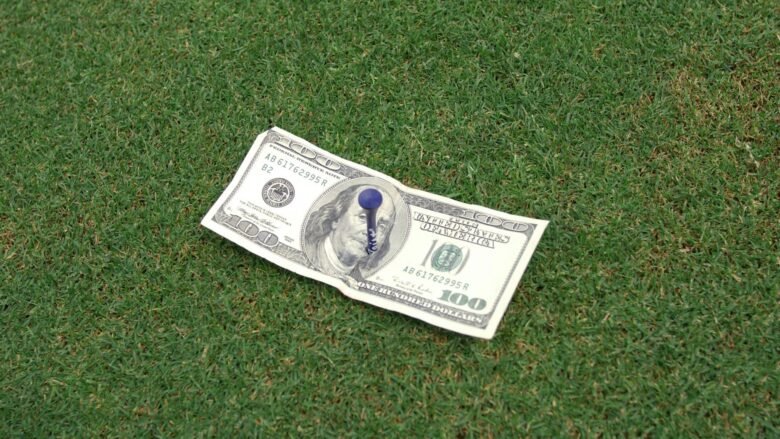
How much did you pay for your last round of golf?
If you played Sharp Park, just south of San Francisco — the only seaside municipal course in the country designed by Alister MacKenzie — your green fees topped out at $86. That’s roughly one-fifth of what it costs to play Pasatiempo, the next nearest public-access MacKenzie layout, 50 miles down the coast.
The two courses share a designer but differ starkly in conditioning, atmosphere, clientele and ranking. The nearly $350 price gap reflects that. Yet for all that separates them, the properties represent just two points on a spectrum that extends far in either direction, from $5 junior rates at the local muni to north of $1,000 at the highest end. That vast range is one hallmark of a game that is booming as never before.
Between 2019 and 2025, golf participation in the United States swelled by 41 percent and is now closing in on 50 million participants, according to the National Golf Foundation (NGF), which counts participants as people who played either on a green-grass course or at an off-course facility such as a range or simulator venue. Annual rounds played have reached record numbers. But that headline figure obscures another statistic worth sitting with: market research shows that 7 to 8 percent of golfers account for approximately 80 percent of total spending in the game. The boom is real, but it is not evenly distributed, an imbalance that helps explain what has happened to prices.
Growth, of course, hardly counts as bad news. But it has come with grumbling, and not just from golfers who have to wake up earlier, or click more quickly, to nab a tee time at their favorite course. A common sentiment among consumers is that the costs of playing have gotten out of hand.
The data, at least at the national level, tells a more measured story. A recent NGF analysis of public-access rates found that from 2019 through 2025, average green fees rose by around 29 percent, an increase largely on pace with inflation and relatively modest by sports and entertainment standards. By comparison, the NGF reported, the cost of attending an NFL game has risen around 50 percent over the past six years. The price of a movie ticket has jumped some 60% over that same period.
Such aggregate pictures can be valuable. There’s plenty to learn from them. Still, there are limits to what they show.
“National numbers are great,” says Jon Last, founder and president of Sports and Leisure Research Group, a New York-based marketing research consultancy. “But they only get you so far if you don’t have a good sense as a facility operator of what your specific situation can bear.”
A more detailed portrait reveals what Last describes as a “hyper-local reality” — a picture that shifts dramatically from one zip code to the next, and one that mirrors a K-shaped economy running through American life. The rich are getting richer, and they’re spending accordingly. That’s most glaringly apparent in the proliferation of high-end private clubs with tiny memberships and exorbitant dues. But the public-access numbers hint at the phenomenon, too. Since 2019, the NGF reports, average resort green fees have climbed by 36 percent, with average peak-season rates at those properties now exceeding $100. The figure does not account for a slate of variables, including seasonal discounts and replay rates. But no matter how you slice it, it is significantly more than the just-over $41 average at municipal and daily-fee courses.
What’s true in other sectors ranging from air travel to automobiles applies to golf: the price gap grows more rapidly the higher up the spending scale you go.
Augusta National helped remake this beloved muni — with green fees starting at $20
By:
Sean Zak
As the gulf between the game’s haves and have-nots expands, the middle of the market risks thinning out. The most imperiled courses in the current climate are privately owned, daily-fee properties near big cities, where land and labor are expensive. Those are the ones most likely to close, says Jay Karen, CEO of the National Golf Course Owners Association (NGCOA), and they aren’t likely to be replaced.
“Nobody I know is building a regulation, 18-hole daily fee golf course in a high-population area,” Karen says. “It doesn’t pencil out to do that anymore.”
Farther-flung courses are a different story. The remote golf craze owes in part to the quality of the designs and the beauty of the settings. But it has also been propelled by a less romantic factor: Those places are where golf makes business sense. Location, location, location. Call it a new spin on an old rule.
As for green fees, Karen says the rising numbers require context. During a 15-year stretch from 2005 to 2019, when golf participation largely held steady or declined, prices lagged behind the cost of living. In real terms, the game got cheaper. That courses now charge more doesn’t mean they’re rolling in profits or price-gouging. Many are simply playing catchup, either pouring money into deferred improvements or setting it aside for a rainy day, such as the day the irrigation system finally gives out.
“Golfers for the most part don’t understand how expensive it is to run a course,” Karen says. “The truth is, if you want your course to stick around, you’ve got to pay a reasonable price for it.”
In generations past, golf course development was driven largely by real estate: subdivisions with layouts stitched through them. Those days are gone, Karen says, and they aren’t coming back, “unless we want to start building housing with courses in the middle of nowhere, which I don’t see happening.”
What the supply might look like in future generations ranks high on Karen’s list of concerns. The accessible path forward, many in the industry agree, runs across public land. Karen and others see the municipal sector as the game’s most viable outlet for keeping traditional golf within reach of ordinary players. Not only is NGCOA bullish on munis, but private backers have gotten behind them too, in initiatives aimed explicitly at keeping high-quality golf affordable and accessible. Projects like the Patch in Augusta, the Park in West Palm Beach and Cobbs Creek in Philadelphia have attracted serious capital and ambition.
That’s a sunny side of the story. At the same time, Karen says, “we are also hearing pain points” brought on by the post-Covid boom: packed tee sheets, for instance, that squeeze out discounted junior programs, and players who can’t get a reservation at all. No one wants to see their neighborhood course become like the restaurant Yogi Berra once dismissed: so popular that nobody goes there anymore. Access remains a stubborn issue. Alt-golf venues — short courses, simulator bays, gamified ranges and such — have addressed it on the margins. The traditional game is working hard to keep up.
Further complicating consumer patterns is a shift that economics alone don’t capture. Since the pandemic, and against a backdrop of global instability, consumers across a range of income brackets increasingly have prioritized leisure time now, says Last of Sports and Leisure Research Group. Even golfers who never studied Latin appreciate the phrase carpe diem, and they’re acting on it, whether or not their salaries are equal to the spend. How long that will continue is impossible to know. But in the meantime, the industry keeps adding to its catalog of splurges.
The result is a different kind of bifurcation — not separate rules and equipment for pros and amateurs, but disparate experiences for golfers.
Does a round count as bargain or an extravagance? It’s complicated. But as Karen sees it, such complications are an industry strength.
“Golfers have all kinds of motivations for where they play and why, and the price tag is simply one variable,” he says. “The complexities of the golf economy have allowed it to survive over time. If we were a monolith, and all of a sudden prices went off a cliff, we might see catastrophe. But somehow for 150 years, we have had an industry that has ebbed and flowed and morphed with the times and the people. And I think that will continue.”