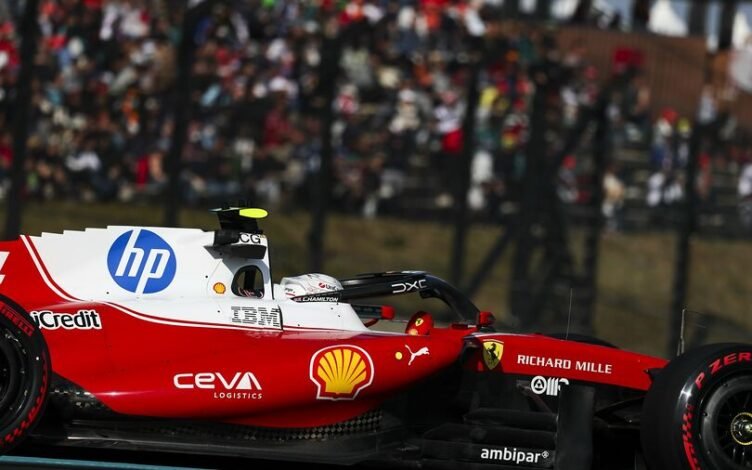
The 2026 Japanese Grand Prix at Suzuka saw Ferrari top the list of fastest pit stops, having serviced Lewis Hamilton’s SF26 in a second record-breaking time of 2 seconds. But were they consistently strong? F1Technical’s senior writer Balazs Szabo delivers his latest analysis.
Ferrari’s pit‑stop execution at the Japanese Grand Prix was not just sharp—it was class‑leading by every measurable metric. The team didn’t merely produce the fastest individual stop of the weekend; they also delivered the strongest average performance across all their tyre changes.
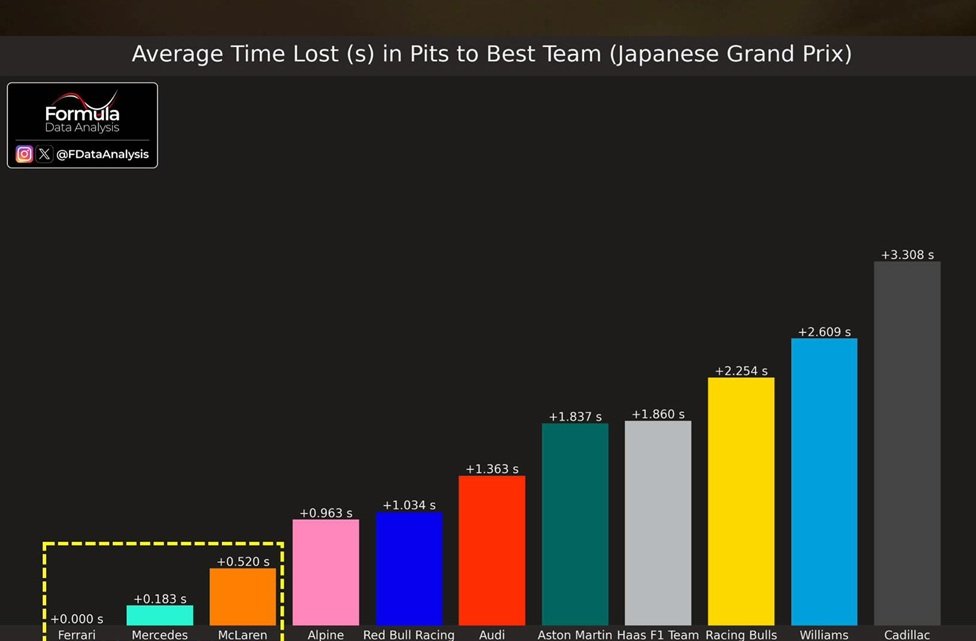
Mercedes emerged as Ferrari’s closest challenger, but even they trailed by a meaningful margin: their average deficit of +0.183 seconds per stop illustrates how consistently precise Ferrari were.
McLaren, often a contender in this area, found themselves further adrift at +0.520 seconds, while Alpine’s +0.963 seconds and Red Bull’s +1.034 seconds underline how the reigning champions’ operational sharpness has slipped relative to Ferrari’s current form.
Audi (+1.363 seconds) and Aston Martin (+1.837 seconds) were firmly in the midfield of pit‑lane performance, losing well over a second per stop compared to Ferrari.
At the back of the order, Haas (+1.860 seconds), Racing Bulls (+2.254 seconds), and Williams (+2.609 seconds) all struggled to match the top teams’ rhythm, while Cadillac’s +3.308 seconds average loss placed them last—effectively conceding more than three seconds to Ferrari every time they serviced the car.
What makes Ferrari’s achievement stand out is not just the raw speed but the operational consistency behind it. In a field where the spread from first to last exceeds three seconds, Ferrari’s ability to hit the same high standard stop after stop is a competitive weapon. At Suzuka—where track position is notoriously difficult to regain—those fractions of a second mattered. Ferrari maximised them.
The Italian team’s performance in Japan reinforces a broader trend: Ferrari are no longer just fast on the stopwatch, having been Mercedes’ closest rival in the early stages of the all-new technical era, but they are executing at a level that supports their race strategy rather than compromising it.