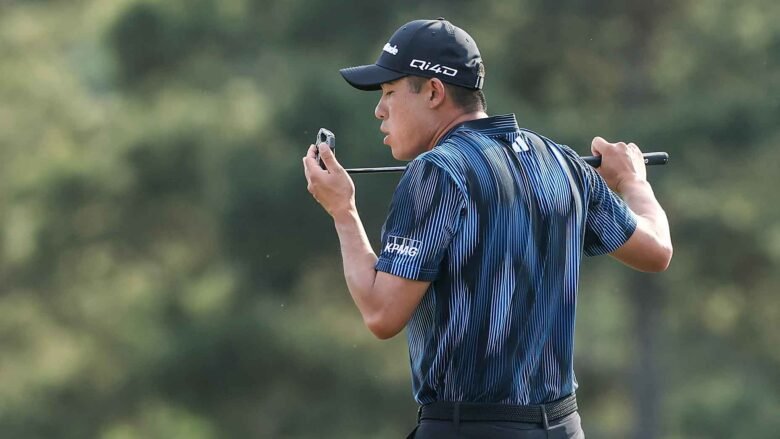
The tenor of press conferences shift throughout any Masters tournament, but never more than on Sundays. The build-up to the final round is most often a stream of optimism that gets dented slightly here and there as players moving closer to contention. But the instant the buzzer sounds, when there are no more holes left to play, the reasons for optimism get drowned by the reality of a non-victory setting in.
Take Cam Young, for example, who got stuck in neutral Sunday and kept responding to queries about what he’d do differently with … well, not much. He wouldn’t change much at all. Or take Scottie Scheffler, who lost by one, and whose first instinct was to blame that Friday round he played in conditions he didn’t think were fair to the entire field.
For obvious reasons, Rory McIlroy is beyond happy as the defending champ, but this list of displeased golfers is always going to trump the list of happy pros. Mild-mannered Tommy Fleetwood called his weekend scoring “dreadful” and his short game “awful.” Shane Lowry didn’t bother to chat about his final-round 80. Jacob Bridgeman started his press conference expressing how frustrated he was.
All of which brings us to a surprising admission from the shortlist of happy boys. Consider Collin Morikawa. But not just his Masters week — let’s think about his 2026 season.
After a slow start, he broke through with a win at the AT&T Pebble Beach Pro-Am, adding a couple of top 10s in the Signature Events that followed. He was playing “Collin Golf,” as he likes to call it. Power fades off the tee and flagging iron shots. That is precisely where you want to be in the lead-up to the Masters, and Morikawa was on everyone’s shortlist of Masters favorites — until he pulled up lame on the opening morning of the Players Championship with a balky back.
He didn’t get any extra starts ahead of the Masters and showed up gingerly in practice rounds. He wasn’t going full speed on the driving range and was limiting his total driver swings. He woke up more nervous for Thursday’s opening round than any other he could remember. His back was so tight that he needed his legs to support his body more than ever — and he didn’t feel he could trust it.
But then he found something. Some thing. A move that worked with his arms more than his core and a mental thought that allowed him to push forward. He shot 74 in his opening round, but you could see he was rigid. His swing was something less than its normal, fluid, forceful self. But after a six-birdie 69 Friday he was … content.
“Trust me,” he said after making the cut, “the last two days were some of the best golf. No matter what I would have shot, but truthfully, today was probably the best golf I could have played.”
Morikawa was never truly in the hunt, as they say, on the weekend at Augusta National. But he also never blew up. The back strain never left him hobbled. It wasn’t until a poor swing on the 2nd hole in the final round that he carded anything worse than a bogey. He was … afloat. And loving the grind. He couldn’t go for par 5s in two. Couldn’t manage much for ball speed. But he hit 73% of his fairways and 67% of greens — both better than the field average. And then, after a barrage of four straight birdies on the final nine holes, he found himself in the top 10.
“This blew by any expectations I had for the week,” Morikawa said late Sunday night. “Honestly, for me it was just survive each day — wake up, do the prep I needed to do, and go and tee off on [hole] 1. I didn’t know how uncomfortable it was going to be, but we managed to get through all 18 and all 72.”
The golf he played was decidedly not Collin Golf, but it seemed to work. He lost strokes to the field off the tee, which would be abnormal for him and his famously accurate tee game. He cashed plenty of putts, though, which will always mask plenty of what’s happening underneath. He finished third for the week in Strokes Gained: Putting, and best of anyone who made the cut. He very simply stayed in the fight and learned something along the way.
“It’s going to be one of the best tournaments forever,” Morikawa said. “I’m going to remember this one for many reasons, but just more how strong the mind is, to be able to go out and convince yourself that everything is going to be okay.”