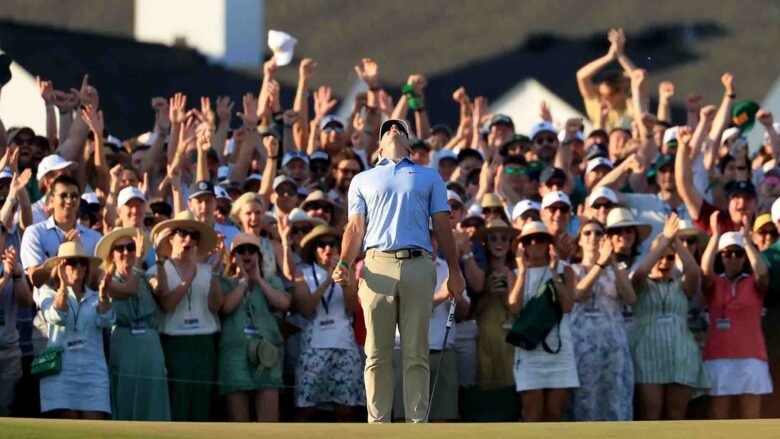
Rory McIlroy carried the weight of expectations, the burden of grand dreams, for 14 years. It was crippling at times, and then in a moment of catharsis last April, it all melted away. The long road to his dreams finally ended when he rolled in a 4-foot putt to win the 2025 Masters and crumpled to the ground, having been released from years of torment.
But what Rory McIlroy found at the place where his dreams became reality was something he didn’t expect. Shedding those ghosts as the sun set on Augusta National didn’t bring him self-fulfillment but instead sent him in search of something else. What now? McIlroy wondered in the months after he finally caught the car he’d spent his entire life chasing. A malaise known as post-achievement depression ensued. It’s a common psychological phenomenon in which people suffer emotional emptiness after achieving a long-term goal. For McIlroy, he was stuck in a purgatory between celebrating and wandering.
“Look, you dream about the final putt going in at the Masters, but you don’t think about what comes next,” McIlroy said at last year’s U.S. Open.
Human beings are, by nature, dreamers, searchers. Self-actualization is not found in completing one quest. We lust for more, for the next peak, the next challenge. What McIlroy found in the wake of his defining achievement, in the glow of his forever moment, was an existential question that humans have long tried to solve: If there can always be something else to chase, how can you ever be truly fulfilled? A summer of media squabbles and mediocre finishes followed as McIlroy tried to navigate his new reality. Things turned during a home Open at Royal Portrush, and he won the Irish Open and an away Ryder Cup. He arrived as the defending champion at this year’s Masters, liberated at a place he has long wanted to love him back — one that used to bring him only pain.
That’s the thing about weight: put too much in one place, and you can’t move; remove it all, and you’ll float; but shift the location and amount of load, and it becomes beneficial.
Rory McIlroy’s 2025 Masters win was an unburdening. The freedom it provided him at Augusta National was evident during the early rounds when he built a six-shot lead, and on the weekend when he weathered a collapse and responded to become the fourth player in history to win back-to-back green jackets. McIlroy’s Augusta freedom was not the removal of doubt or anxiety. It was not the disappearance of fear. Instead, it was the liberation that comes from being willing to accept that you might fail — that pain might return and you might only leave with a new set of scars — but you’re willing to jump with conviction because you’ve already proven to yourself that you can fly.
“Good things come to those who wait, maybe. Just keep going,” McIlroy said on Sunday night after winning his sixth major and second Masters. “Just keep going. Keep your head down and keep it going. If you put the hours in and work on the right things, eventually it will come good for you.”
Rory McIlroy doesn’t follow the script. It’s why we can’t get enough
By:
Michael Bamberger
After surviving a rollercoaster weekend at Augusta National to capture another green jacket, McIlroy found another question. This one, he believes, he has the answer to after last year’s search for meaning: Will this win lead to a similar rut?
“I said at the start of the weekend here, I felt like the grand slam was the destination, and I realized it wasn’t. I’m on this journey.” McIlroy said. “I feel like this win is just — I don’t want to say a stop on the journey, but yeah, it’s just a part of the journey. I still have things I want to achieve. But I still want to enjoy it as well.
“I’ve waited so long to win the Masters, and all of a sudden I win two in a row. So I still want to enjoy it. I’ve got a couple of weeks off before I go back to play competitive golf, but I don’t think I’ll go through that lull of motivation or the sort of things that I was feeling last year, post-winning this tournament.”
One scene Sunday evening at Augusta National suggests that this time McIlroy won’t find himself listless in the emerald radiance of his latest achievement.
When he won last year, Rory McIlroy folded onto the perfectly manicured 18th green at Augusta National, put his head in his hands and began to sob. The tears freely flowing, he let out a primal scream signaling only relief that he had finally slayed the dragon, that his long battle with himself and this tournament was over. Relief that after that Sunday, the mental agony of the weight of time and expectation was over. Overcome with the realization that his dreams had finally arrived, McIlroy sobbed uncontrollably as he made his way back to the clubhouse, hugging friends and family along the way. It was a blur.
On Sunday, as McIlroy readied to tap in for a closing bogey to beat Scottie Scheffler by one stroke, the tears started to arrive again, but everything else about this moment was different.
This time, McIlroy didn’t collapse. His head didn’t drop in disbelief that the long journey had ended. Instead, he lifted his head immediately to the sky and let another scream, not one of catharsis but one of pure jubilation. A huge smile stretched across his face and he laughed as he hugged caddie Harry Diamond. As he walked to the clubhouse after hugging his wife, daughter, parents and some friends, Rory McIlroy lifted both of his arms in the air and soaked in a moment of pure, unadulterated joy.
This time, Rory McIlroy’s system wasn’t in shock. He wasn’t shedding anything. There was no recalibration needed. The ghosts have long gone.
There was just Rory McIlroy, a two-time Masters champion, reveling in a victory that hit similar themes but meant something different. He did so with his eyes forward, locked on the horizon, not in search of the finish line but with his soul’s compass pointing in the only direction humans can go: forward.